XML Sitemap vs RSS Feed: Which Helps Indexing Faster?

TL;DR
XML sitemaps are best for complete URL discovery, while RSS feeds are best for recent-update signals. High-change publishers, SaaS blogs, marketplaces, and affiliate sites should usually use both, then monitor submission and crawl behavior through a dedicated workflow.
Fast indexing rarely comes from one file. The XML sitemap vs RSS feed decision matters because search systems need both a full URL map and a clean signal for what changed recently. XML sitemap: an XML protocol file that lists crawlable URLs for search engines. RSS feed: a standardized web feed for recent site updates. Indexerhub helps teams track these discovery signals without turning indexing into guesswork.
Table of Contents
What is the core difference between an XML sitemap and an RSS feed?
An XML sitemap is a durable inventory of important crawlable URLs, while an RSS feed is a rolling update stream for newly published or recently changed content. Wikipedia describes sitemaps as an XML protocol for informing search engines about available URLs, and RSS as a machine-readable feed for website updates.
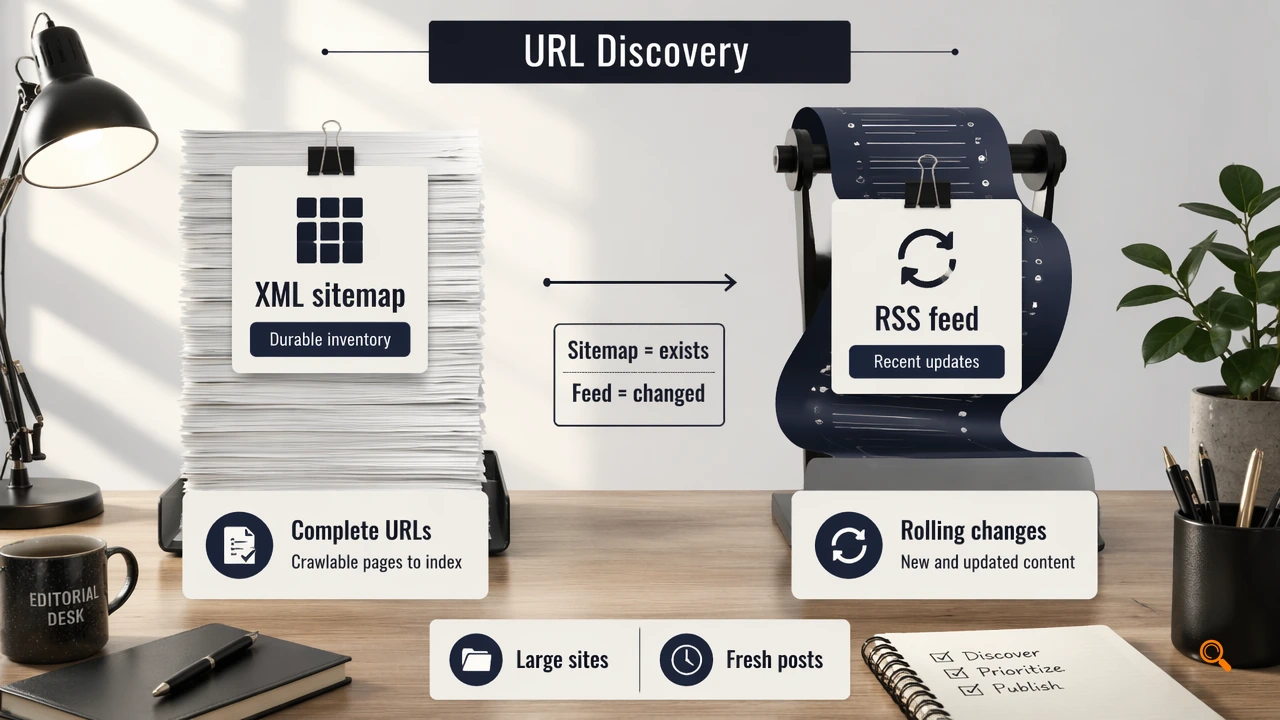
Key insight: a sitemap answers what should exist in search, while a feed answers what changed most recently.
Comparison table for SEO discovery
| Format | Primary SEO role | Best fit | Typical contents |
|---|---|---|---|
| XML sitemap | Complete URL discovery | Large sites, archives, category pages, product pages | Canonical URLs, optional last modification data |
| RSS feed | Freshness and update discovery | Blogs, newsrooms, changelogs, frequently updated hubs | Latest posts or updated entries |
| Atom feed | Similar update feed role | Technical publishers and apps using Atom | Recent entries with structured metadata |
A 2026 publisher should not treat these files as duplicates. Search engines can crawl URLs from both, but the intent differs. A sitemap supports coverage across the site, while a feed narrows attention to the newest items.
Public SEO discussions, including an older Webmasters Stack Exchange thread about RSS URLs in sitemaps, show why confusion persists: both use XML, but they do not serve the same operational purpose.
When should publishers use each format for freshness and recrawling?
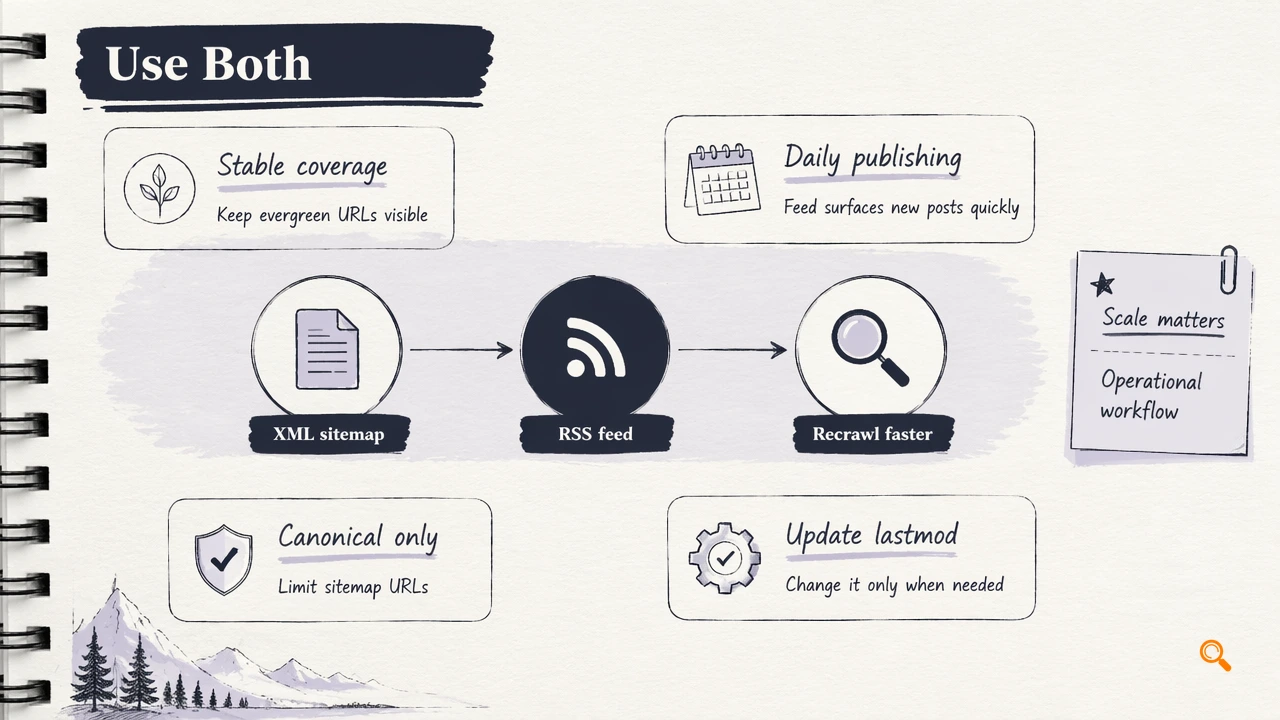
Publishers should use XML sitemaps for stable crawl coverage and RSS feeds for faster discovery of recent changes. For a site that publishes daily, the feed can surface new content quickly, while the sitemap keeps older, evergreen, and commercial URLs visible for crawlers.
SERP analysis for this topic found 116 results and an average competitor article length of 1,181 words, yet many results still focus on definitions instead of operational workflows. That gap matters for content teams publishing at scale.
Recommended workflow for high-change sites
- Keep the XML sitemap limited to canonical, indexable URLs.
- Update
lastmodonly when meaningful page content changes. - Keep RSS or Atom feeds focused on the newest or recently updated entries.
- Submit sitemap locations through search engine tools where supported.
- Monitor crawl and indexing signals after major publishing batches.
RSS should not become a full archive. Large feeds can dilute the freshness signal and make update monitoring harder. XML sitemaps should not include non-indexable URLs, redirects, internal search results, or parameter variations.
For agencies and SaaS content teams, the Indexerhub platform fits after files are generated: it helps create a repeatable indexing process around submission, monitoring, and follow-up. Teams can also visit indexerhub.com when indexing visibility needs a more structured workflow.
Which format should win the XML sitemap vs RSS feed decision in 2026?
Neither format should win alone for large or frequently updated sites in 2026. The practical answer is to use an XML sitemap as the source of URL completeness and an RSS or Atom feed as the source of publishing freshness.
Google-focused competitor content from 2025 in the research set recommends using both XML sitemaps and RSS or Atom feeds for optimal crawling. That aligns with current practice: crawlers need breadth, then they need change signals.
Best practice: use the sitemap for the full crawlable set, use the feed for the latest changed set, then measure whether important URLs enter the index.
Decision rules by site type
- News site: prioritize RSS or Atom freshness, backed by a clean sitemap.
- SaaS blog: use both, especially for changelogs, docs, and product-led content.
- Marketplace: rely on segmented XML sitemaps, with feeds for editorial or newly listed content where appropriate.
- Affiliate site: keep evergreen reviews in sitemaps and new posts in the feed.
- Programmatic SEO site: split sitemaps by template or content type to make crawl issues easier to diagnose.
A Moz community discussion on Atom, RSS feeds, and XML sitemaps reflects the same long-running SEO question: which one is better. The stronger 2026 framing is not better, but role-fit. Indexerhub supports that role-fit by giving indexing work a process after discovery files are published.
Conclusion
The XML sitemap vs RSS feed choice should end with a combined setup, not a winner-takes-all answer. A clean sitemap, a focused feed, and routine monitoring give search engines both breadth and freshness. For teams that need a repeatable indexing workflow, head to indexerhub.com and audit which URLs deserve faster discovery first.