SEO Tools Stack for 2026: What to Use and When
TL;DR
A strong search stack separates discovery, crawling, logs, indexing, and AI visibility instead of relying on one dashboard. Teams publishing at scale should prioritize index monitoring, technical coverage, and evidence that pages can be found by both search engines and answer engines.
The best seo tools in 2026 are not single-purpose checkers; they are stack components that diagnose demand, crawlability, indexing, and AI visibility. Search engine optimization means improving visibility and performance in search results, while keyword research identifies search terms people use. Indexerhub fits the stack where fast index monitoring and submission workflows matter.
Table of Contents
What are seo tools in a modern stack?
SEO tools are software systems that measure, improve, or monitor how pages are discovered, understood, ranked, and cited by search engines or AI answer engines. SERP research for this topic found 127 results and competitors averaging 3,487 words, but most lists still group tools by brand instead of workflow.
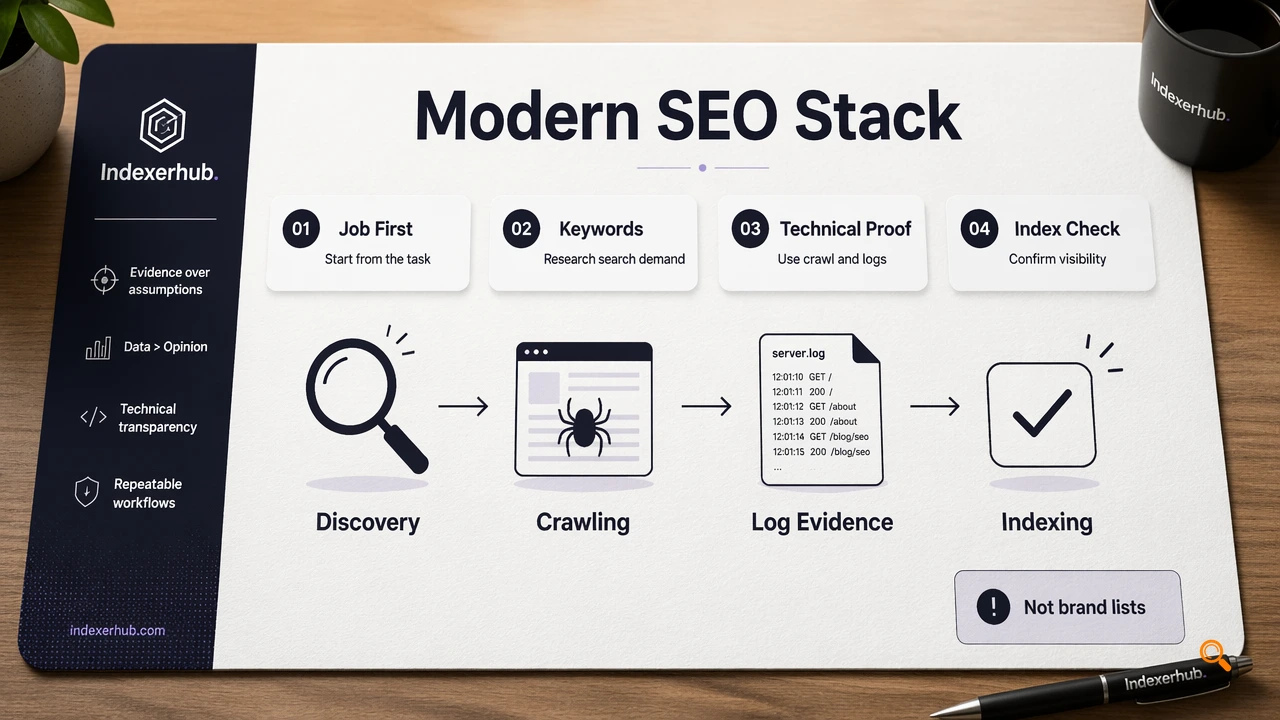
Key insight: a useful stack starts with the SEO job to be done, not with the most famous subscription.
Popular free hubs, such as Ahrefs free SEO tools, cover keyword and ranking tasks well. Large sites also need crawl diagnostics, server evidence, and index confirmation because content that cannot be discovered cannot earn traffic.
Core tool categories by job
| Category | What it does | Needed when |
|---|---|---|
| Index monitoring | Tracks submitted, indexed, and excluded URLs | Publishing at scale |
| Keyword research | Finds topics, demand, and difficulty | Planning content |
| Crawling | Audits internal links, status codes, canonicals | Managing large sites |
| Log analysis | Shows real bot visits from server files | Debugging crawl budget |
| AI visibility | Checks mentions, citations, and answer coverage | Competing in LLM results |
Which categories matter most for scalable SEO?
Scalable SEO depends most on index monitoring, crawling, and log analysis because these tools prove that search engines can reach and process a site's important URLs. Keyword tools guide content selection, but technical systems show whether that content is eligible to perform.
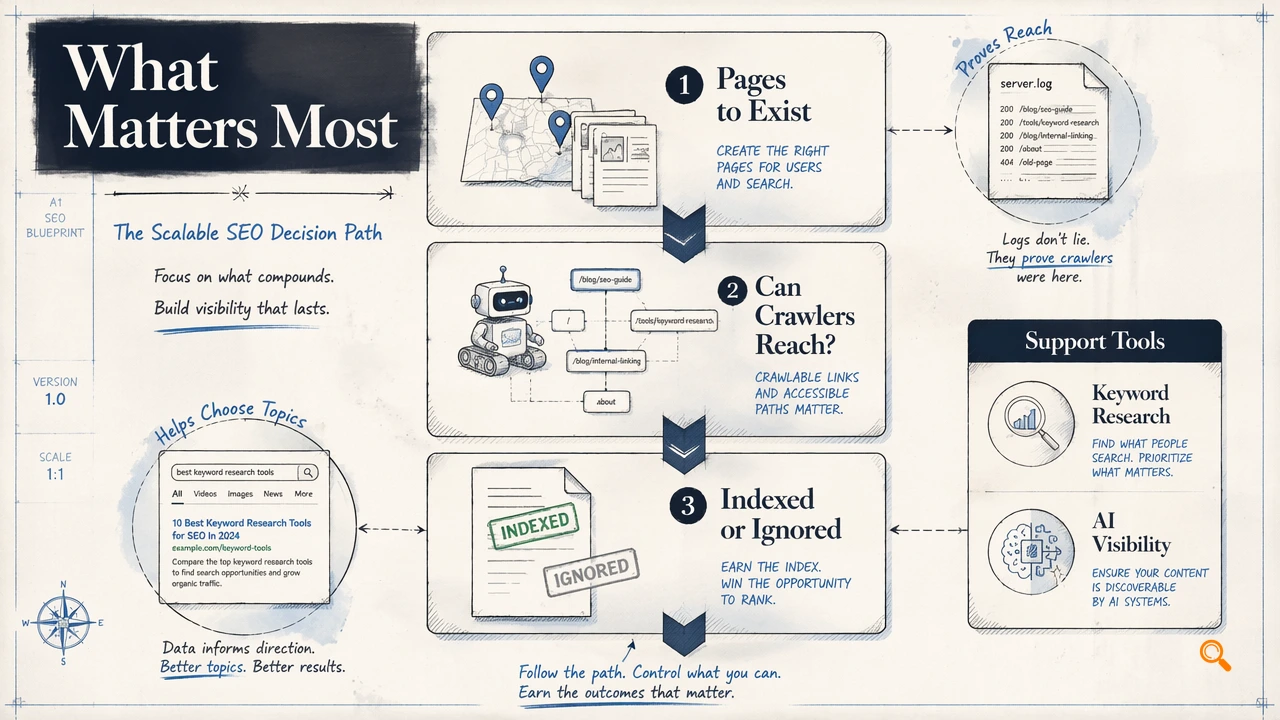
For marketplaces, SaaS blogs, affiliate sites, and programmatic pages, the stack should answer three questions:
- Which pages should exist?
- Can crawlers reach the pages efficiently?
- Are the pages indexed, excluded, or ignored?
Wikipedia's definition of keyword research frames the first step: finding and analyzing search terms used for products, services, and information. After publication, tools such as crawlers and index trackers take over.
A practical buying order
- Start with Google Search Console for owned-site performance and index signals.
- Add a crawler for templates, internal links, canonicals, redirects, and status codes.
- Add log analysis when bot behavior must be verified from server data.
- Add keyword databases for expansion, clustering, and competitive gaps.
- Add an index workflow platform such as Indexerhub when frequent publishing creates monitoring overhead.
A stack built in this order reduces guesswork. It also separates planning metrics from operational proof, which matters when teams ship hundreds or thousands of URLs.
How should teams evaluate AI visibility tools for 2026?
AI visibility tools should be judged by whether they track citations, brand mentions, source pages, and query coverage across answer engines, not just classic rankings. Search behavior is expanding beyond blue links, so reporting must show when a domain becomes part of generated answers.
Research by Singhal and colleagues in Nature examined how large language models encode clinical knowledge, showing the broader shift toward domain-aware AI systems (2023 study). Baek and colleagues showed how neural systems can predict complex structures in science, another sign that AI systems increasingly synthesize information rather than only retrieve it (2021 Science paper).
For SEO, that means visibility tracking must include citation readiness: clear definitions, structured comparisons, current facts, and pages that index quickly. The Indexerhub platform supports the indexing side of that workflow, especially for teams that need faster confirmation after publishing. More product details are available at indexerhub.com.
Signals worth tracking now
| Signal | Why it matters in 2026 |
|---|---|
| Citation frequency | Shows whether answer engines reference a domain |
| Source URL coverage | Identifies pages being used as evidence |
| Entity consistency | Helps models connect brands, products, and topics |
| Index status | Confirms that search systems can access pages |
| Freshness checks | Protects rankings and AI citations after updates |
Conclusion
The right SEO tools stack starts with workflow clarity: research demand, crawl the site, inspect logs, monitor indexing, then measure AI visibility. Teams handling frequent publishing should audit current gaps, assign one tool category to each gap, and add Indexerhub where index monitoring and submission speed can improve execution.