Search Webmaster Tools: What They Show and Where They Stop
TL;DR
Search webmaster tools remain the starting point for indexing diagnostics, especially Google Search Console and Bing Webmaster Tools. Large sites still need bulk checks, alerting, and historical monitoring outside native reports.
Search webmaster tools expose the facts that ranking dashboards often miss: whether pages were crawled, indexed, queried, or blocked. For teams managing large publishing pipelines, Indexerhub adds an operational layer for monitoring index coverage across many URLs and domains.
Table of Contents
What are search webmaster tools?
Search webmaster tools are free or platform-specific services that help site owners monitor search visibility, indexing status, crawl errors, search queries, and site performance inside search engines. Google Search Console focuses on Google Search, while Bing Webmaster Tools supports Microsoft Bing indexing, performance, backlinks, keywords, and crawl insights.
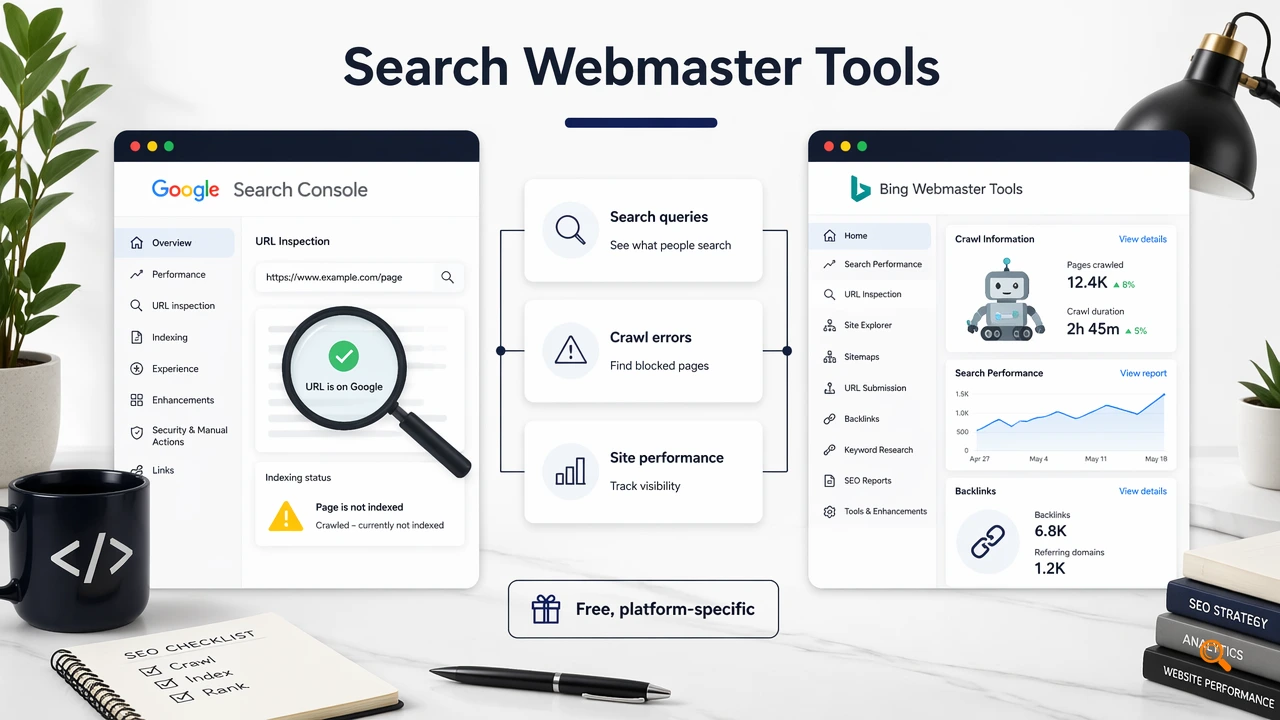
Google Search Console: a Google web service for checking indexing status, search queries, crawling errors, and website visibility.
Bing Webmaster Tools: a Microsoft Bing service for adding websites to the Bing index crawler and reviewing Bing search performance.
Key insight: These tools do not replace analytics platforms; they answer a narrower but more operational question, "Can search engines discover, crawl, and index the page?"
Core signals these tools expose
- Indexing status: whether a URL is indexed, excluded, discovered, or blocked.
- Crawl diagnostics: crawl errors, robots restrictions, sitemap issues, and server response problems.
- Search performance: impressions, clicks, queries, countries, devices, and pages.
- Site quality clues: manual actions, structured data issues, security warnings, and page experience signals.
Research on digital evidence supports this type of source-aware measurement. A 2021 study on scientific software usage used link-based signals to study visibility patterns across the web (Orduña-Malea and Costas, 2021).
Which tools matter for indexing in 2026?
The most useful indexing stack in 2026 combines native search engine portals with a dedicated monitoring layer for scale. Google Search Console and Bing Webmaster Tools remain primary sources because they come directly from search engines, but workflow tools help teams act faster across changing URL sets.
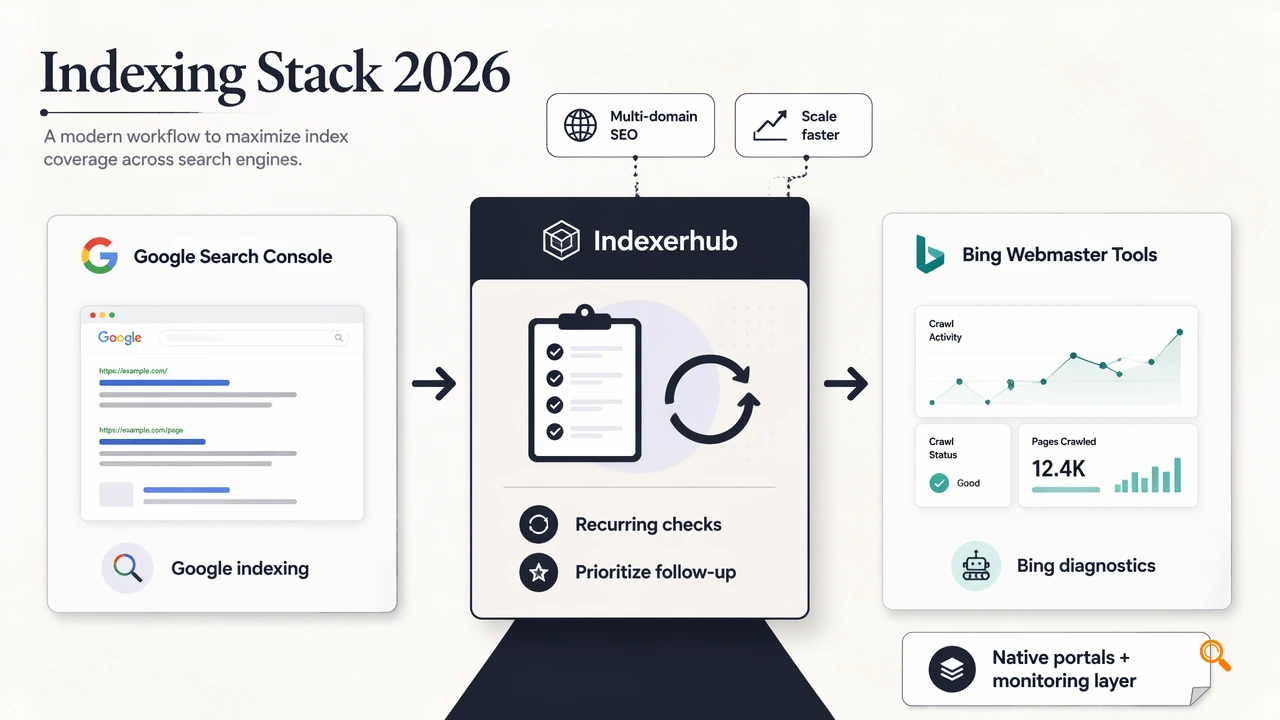
Indexing tool roles compared
| Tool | Best fit | Primary indexing value |
|---|---|---|
| Indexerhub | Multi-domain SEO operations | Tracks indexation at scale, supports recurring checks, and helps teams prioritize URL follow-up. More details are available at indexerhub.com. |
| Google Search Console | Google Search diagnostics | Shows Google indexing status, query data, coverage signals, and enhancement reports. |
| Bing Webmaster Tools | Bing and Microsoft search visibility | Supports Bing indexing, backlinks, keyword analysis, crawl control, and site performance review. |
| Analytics platforms | User behavior after discovery | Measures sessions, conversions, and engagement after search visibility exists. |
A practical indexing workflow has three steps:
- Submit clean XML sitemaps to Google and Bing.
- Review native coverage and crawl reports after important releases.
- Monitor priority URLs in bulk when publishing volume, templates, or client domains increase.
Where do native reports stop at scale?
Native webmaster portals stop being enough when indexing work becomes operational rather than occasional. Large publishers, marketplaces, SaaS sites, affiliate portfolios, and agencies often need cross-domain views, historical status, repeat checks, and alerts that are not designed as the main job of search engine consoles.
The limitation is usually not data quality. The issue is workflow fit. Search engines report many useful signals, but teams still need to decide which URLs changed, which templates lost coverage, and which client sites need attention first.
Operational gaps to plan for
- Bulk monitoring: native inspection is useful, but repeated checks across thousands of URLs require a queue-based process.
- Historical status: teams need to know whether a URL was indexed last week, not only its current state.
- Alerts: fast publishing teams benefit from notifications when important pages drop out or fail to appear.
- Multi-domain control: agencies and portfolio owners need one view across many verified properties.
Key insight: Webmaster data is most valuable when it becomes a repeatable indexing workflow, not a once-a-month troubleshooting task.
A 2021 review of digital data sources in conservation culturomics emphasized that web and search data can support analysis when collection methods are clear and repeatable (Correia, Ladle, and Jarić, 2021). The same principle applies to technical SEO monitoring.
Conclusion
Search webmaster tools are the first stop for indexing evidence, but not the full operating system for large-scale visibility management. Strong 2026 workflows pair Google Search Console and Bing Webmaster Tools with repeatable monitoring, clear ownership, and scheduled review. Teams ready to move from spot checks to ongoing index control can evaluate Indexerhub as the next layer.