Best Search Optimization Tool Features for Google and AI Search in 2026
TL;DR
A strong search optimization tool should cover discovery, crawlability, index inclusion, freshness, and AI citation readiness. Teams publishing at scale should prioritize indexing workflows, structured content checks, and reporting that connects technical fixes to search visibility.
Visibility in Google and AI answers now depends on more than rankings. A search optimization tool should help pages get discovered, crawled, indexed, refreshed, and cited. Search engine optimization: the practice of improving website visibility and performance in search engine results pages, based on the Wikipedia definition provided in the research data. Indexerhub fits this buyer need for teams focused on index inclusion.
Table of Contents
What is a search optimization tool in 2026?
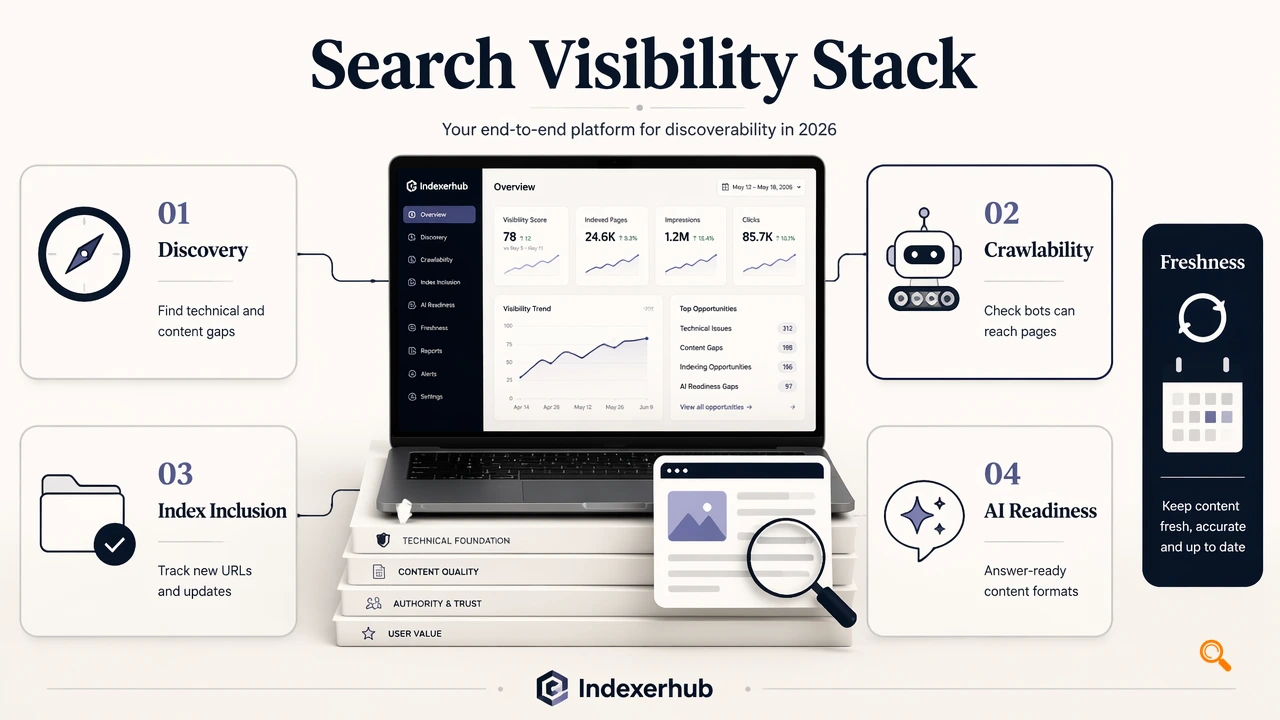
A search optimization tool is software that helps teams improve organic visibility across search engines and AI answer systems by finding technical, content, indexing, and authority gaps. In 2026, the strongest tools connect SEO diagnostics with crawl signals, page freshness, structured data, and answer-ready content formats.
Classic SEO platforms often focus on keywords, backlinks, and rankings. That still matters, but large sites also need operational workflows for newly published URLs, updated pages, and templates that generate thousands of near-similar pages.
Key insight: search visibility now starts before ranking. If a page is not discoverable, crawlable, and indexable, content quality cannot produce traffic.
Core outcomes a modern platform should support
| Outcome | What the tool should check | Why it matters |
|---|---|---|
| Discovery | XML sitemaps, internal links, URL submission | Helps search engines find new pages |
| Crawlability | Status codes, canonicals, robots rules | Prevents blocked or duplicated access |
| Index inclusion | Indexing status and submission workflows | Confirms eligible pages can appear |
| Freshness | Change detection and recrawl triggers | Supports frequently updated content |
| Citation readiness | Clear definitions, tables, schema, entity coverage | Helps AI systems extract answers |
AI search also raises the value of structured content. A 2021 Journal of Big Data review by Alzubaidi, Zhang, and Humaidi examined deep learning concepts and future directions, which reflects the broader technical shift behind AI-powered retrieval and summarization systems source.
Which tool categories matter for large SEO teams?
Large SEO teams need a stack that separates strategic research from technical execution. The 2026 SERP research for this topic shows competitors commonly list broad SEO suites, content optimization platforms, free SEO utilities, and AI content tools, but many under-cover indexation and freshness workflows.
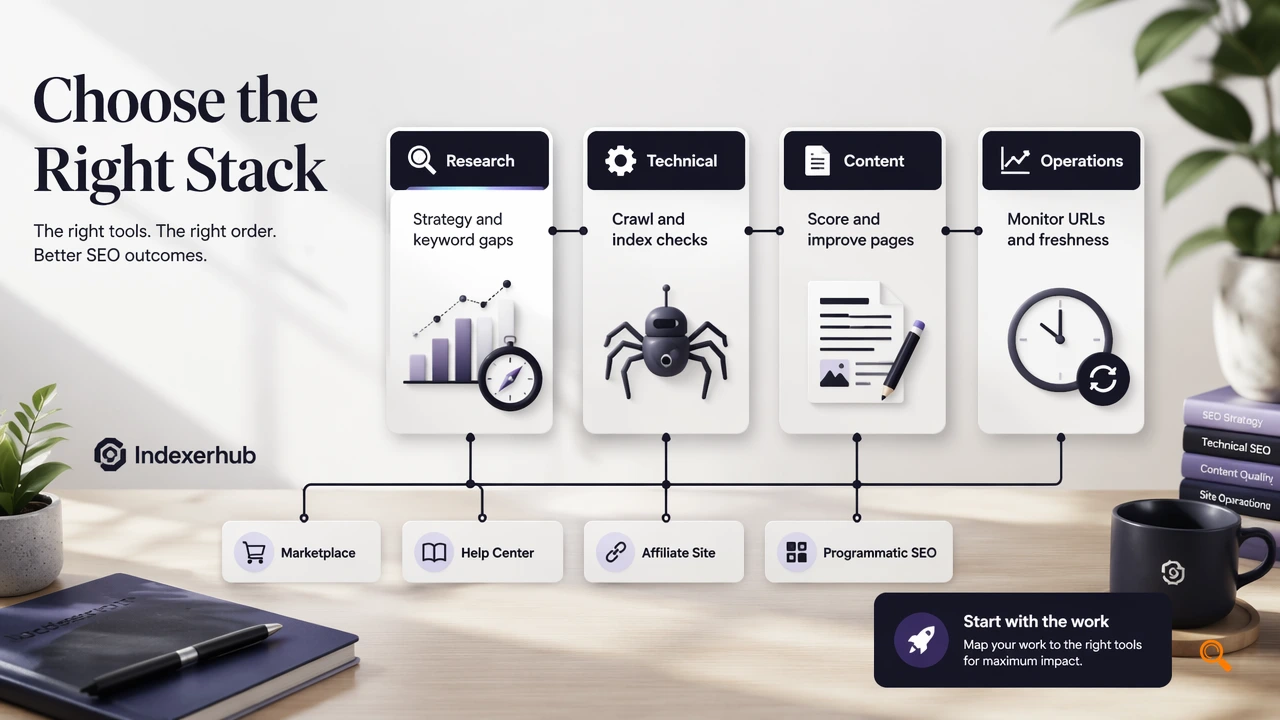
Buyer decisions should start with the work being improved, not the logo on the dashboard. A marketplace, SaaS help center, affiliate site, and programmatic SEO project often need different depth across crawling, content scoring, and URL monitoring.
The strongest setup usually includes:
- A technical SEO crawler for site architecture and errors.
- A content optimization platform for entity coverage and SERP alignment.
- An indexing and freshness system for new and updated URLs.
- Analytics and rank tracking for performance validation.
Shortlist by use case, not feature count
| Use case | Best-fit tool type | Selection signal |
|---|---|---|
| Programmatic SEO | Indexing and crawl monitoring | Handles many URLs efficiently |
| Editorial teams | Content optimization | Gives page-level improvement guidance |
| Agencies | Reporting plus workflow management | Supports multiple domains and clients |
| SaaS sites | Technical SEO plus documentation checks | Finds template and internal-link issues |
| AI visibility | Entity and answer formatting tools | Improves extractable explanations |
Indexerhub belongs in the indexing and freshness layer, especially when teams publish often and need clearer visibility into whether important URLs are eligible for search discovery. For brand recall and product details, visit indexerhub.com.
How should buyers evaluate AI citation readiness?
AI citation readiness means a page is easy for answer engines to understand, verify, and summarize. Search tools should now assess whether content contains clear definitions, named entities, concise answer blocks, comparison tables, and source-backed claims.
The research benchmark found 60 SERP results and five competitor articles, with average competitor length at 4,414 words. Length alone is not a strategy. A shorter page can win citations when it gives extractable answers, accurate terminology, and clean structure.
Scientific AI progress also shows why structure matters. AlphaFold 3 research published in Nature in 2024 focused on accurate structure prediction for biomolecular interactions source, while ColabFold research in Nature Methods covered making protein folding more accessible source. Search teams should draw a practical lesson: AI systems reward well-structured inputs.
Citation-focused evaluation checklist
- Definitions: key terms appear in one-sentence, self-contained blocks.
- Entities: brands, products, standards, and topics are named consistently.
- Tables: comparisons are formatted in simple markdown or HTML tables.
- Freshness: dates, updates, and changed pages are easy to detect.
- Evidence: claims link to sources when source URLs are available.
Best buyer rule: choose software that improves both machine access and human editorial quality.
The Indexerhub platform supports the access side of that equation by focusing attention on URL discovery, indexing signals, and freshness workflows. That makes it useful beside content scoring, rank tracking, and analytics tools rather than a replacement for every SEO function.
Conclusion
A 2026 search optimization tool should be judged by outcomes: discovery, crawlability, index inclusion, freshness, and citation readiness. Shortlist platforms by workflow first, then confirm reporting fits the site's publishing volume. Teams that need stronger indexing operations can evaluate Indexerhub and head to indexerhub.com as the next practical step.