How to Choose a Search Engine Optimization Tool in 2026

TL;DR
A modern SEO stack needs more than rank tracking and site audits. Teams should prioritize URL-level indexing checks, sitemap monitoring, alerts, API access, and multi-domain workflows, especially for large sites and fast publishing programs.
A search engine optimization tool is software that helps improve the visibility and performance of websites in search engine results pages. In 2026, the strongest tools connect classic SEO data with URL-level indexing evidence, because pages that are not indexed cannot rank. Indexerhub is built for that indexing layer.
Table of Contents
What is a search engine optimization tool?
A search engine optimization tool helps teams analyze, monitor, and improve organic search performance across technical SEO, content quality, rankings, links, and index coverage. The best platforms turn search data into repeatable workflows for publishers, SaaS sites, marketplaces, affiliate portfolios, and agencies.
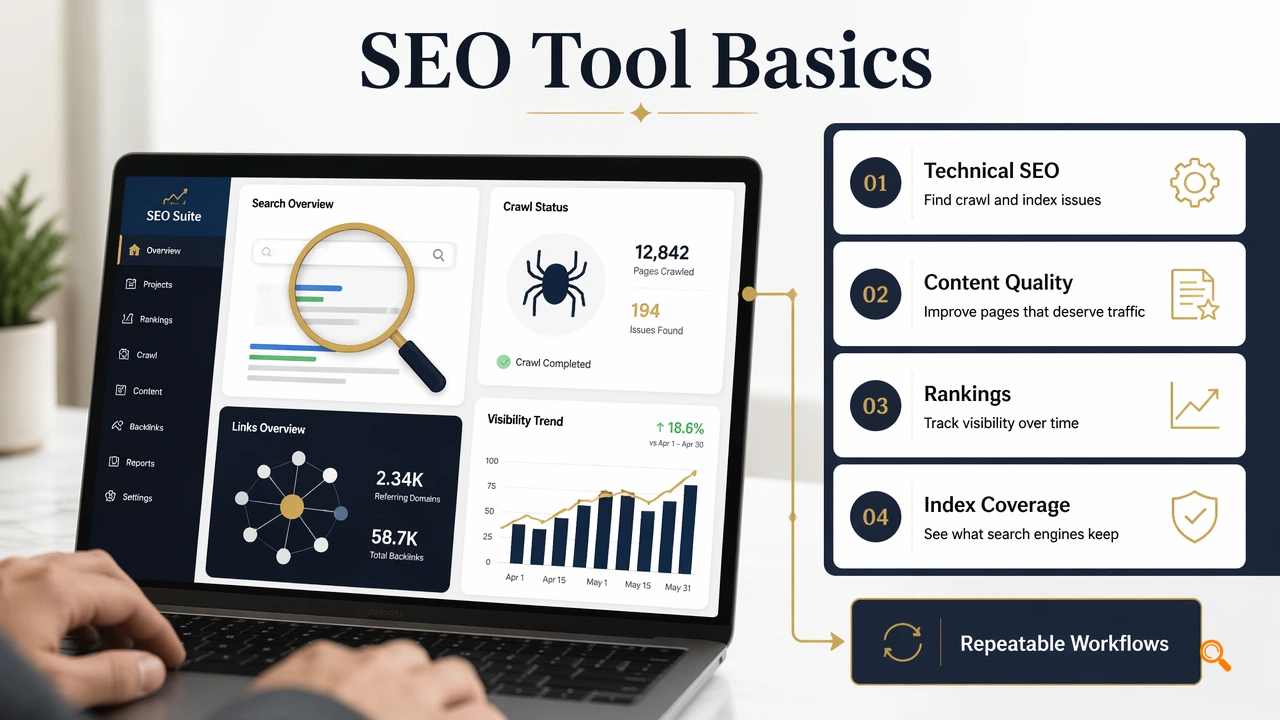
Search engine optimization: the practice of improving a website or web page so it performs better and appears more visibly in search engine results pages.
Traditional SEO suites often focus on keyword rankings, backlinks, crawl errors, and on-page recommendations. Those features still matter, but they do not always prove whether Google has discovered, crawled, indexed, and retained a specific URL.
Key insight: ranking reports explain visible pages; indexing checks explain whether a page has any chance to become visible.
Core SEO tool categories
Most SEO platforms fit into one or more practical categories:
- Audit tools: scan technical issues, metadata, headings, schema, internal links, and page speed signals.
- Keyword tools: research query demand, search intent, difficulty, and content gaps.
- Rank trackers: monitor position changes across locations, devices, and search features.
- Link tools: review backlinks, referring domains, anchor text, and competitor authority.
- Indexing tools: check URL inclusion, submit URLs in bulk, monitor sitemaps, and alert teams when pages drop out.
General SEO guidance from Google Search Central dominates the search results for this topic, while commercial tools such as SEOptimer and SEO Site Checkup position around audits and AI visibility. Buyer-focused evaluation needs to go one layer deeper: URL eligibility, discovery, and index persistence.
Which features matter most for large sites?
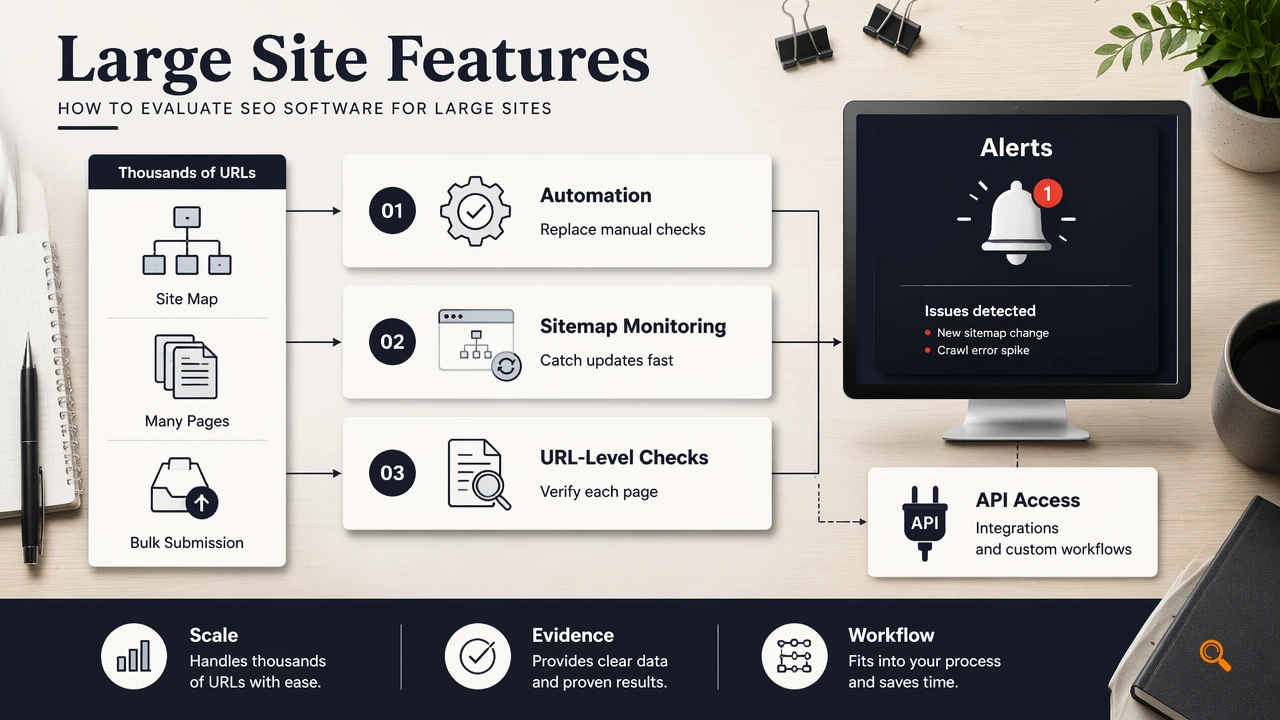
Large and frequently updated websites need SEO software that handles scale, automation, and index verification rather than one-off audits. Programmatic SEO sites, marketplaces, newsrooms, and agencies often publish thousands of URLs, so manual checking becomes too slow and inconsistent.
AI search also raises the standard for structured evidence. A 2021 review by Alzubaidi, Zhang, and Humaidi in the Journal of Big Data examined deep learning architectures, challenges, applications, and future directions, showing how modern information systems increasingly depend on machine learning methods at scale (source). SEO tools now need clean data pipelines that can support both search engines and answer engines.
Indexerhub supports this operational need by focusing on index monitoring and submission workflows that complement broader SEO suites.
Must-have feature checklist
| Feature | Why it matters in 2026 | Buyer signal |
|---|---|---|
| Bulk URL submission | Helps new or updated pages enter discovery workflows faster | Critical for high-volume publishing |
| Index status checks | Confirms whether specific URLs are actually indexed | Essential for revenue pages |
| Sitemap monitoring | Detects gaps between submitted URLs and live indexable inventory | Important for large sites |
| Alerts | Notifies teams when URLs drop, fail, or need review | Useful for agencies and SaaS teams |
| API access | Connects SEO data with CMS, BI, and QA systems | Required for automation |
| Multi-domain workflows | Manages multiple client or portfolio sites in one process | Important for agencies and affiliates |
A buyer should separate reporting features from operational features. Reporting shows what happened; operational tooling helps trigger the next action.
How should teams compare SEO platforms?
Teams should compare SEO platforms by workflow fit, data freshness, automation options, and coverage across the full search pipeline. A tool that looks strong in a demo can still fail if it cannot handle URL volume, client domains, alert rules, or API-driven publishing.
The 2026 SERP for SEO tools includes broad educational resources, free audit pages, and long best-tool lists, including a Morningscore article that says it tested 20 SEO tools in 2026 (source). Those lists are useful for discovery, but procurement should focus on the job to be done rather than the longest feature menu.
A separate 2021 review on physics-informed machine learning by Karniadakis, Kevrekidis, and Lu highlights how models can combine data with domain rules (source). Search operations need the same discipline: raw metrics become useful only when tied to crawlability, indexability, content quality, and business priority.
Practical evaluation steps
- Map the publishing workflow from draft, CMS release, sitemap update, crawl, index, rank, and conversion.
- Identify where current tools stop providing URL-level evidence.
- Test a sample set of new, updated, canonicalized, and low-priority URLs.
- Check whether alerts identify meaningful action, not just more dashboards.
- Confirm API access, export formats, permissions, and multi-domain support.
For teams that already use a broad SEO suite, the Indexerhub platform can serve as the focused indexing layer. More details are available at indexerhub.com for teams comparing indexing workflows against general audit software.
Conclusion
The right search engine optimization tool in 2026 combines strategic SEO insight with operational proof at the URL level. Ranking, audit, and keyword data remain useful, but indexing visibility decides whether new content can compete at all. Build the shortlist around workflow fit, then validate it with a live URL sample before signing a contract.