Search Engine Optimization Services: What to Expect in 2026
TL;DR
Strong SEO support in 2026 should include technical SEO, content strategy, authority building, reporting, and indexation workflows. Buyers should ask providers how pages are discovered, submitted, monitored, and refreshed before signing a contract.
Search engine optimization services now affect more than rankings; they shape how Google, AI Overviews, ChatGPT-style systems, and vertical search engines discover and cite pages. Search engine optimization: the practice of improving website visibility and performance in search engine results. Tools such as Indexerhub help teams connect SEO work to indexation outcomes.
Table of Contents
What are search engine optimization services?
Search engine optimization services are professional activities that improve how websites are crawled, understood, ranked, and measured in organic search. In 2026, a credible SEO program usually combines technical audits, content planning, internal linking, local or ecommerce optimization, authority development, analytics, and AI search readiness.
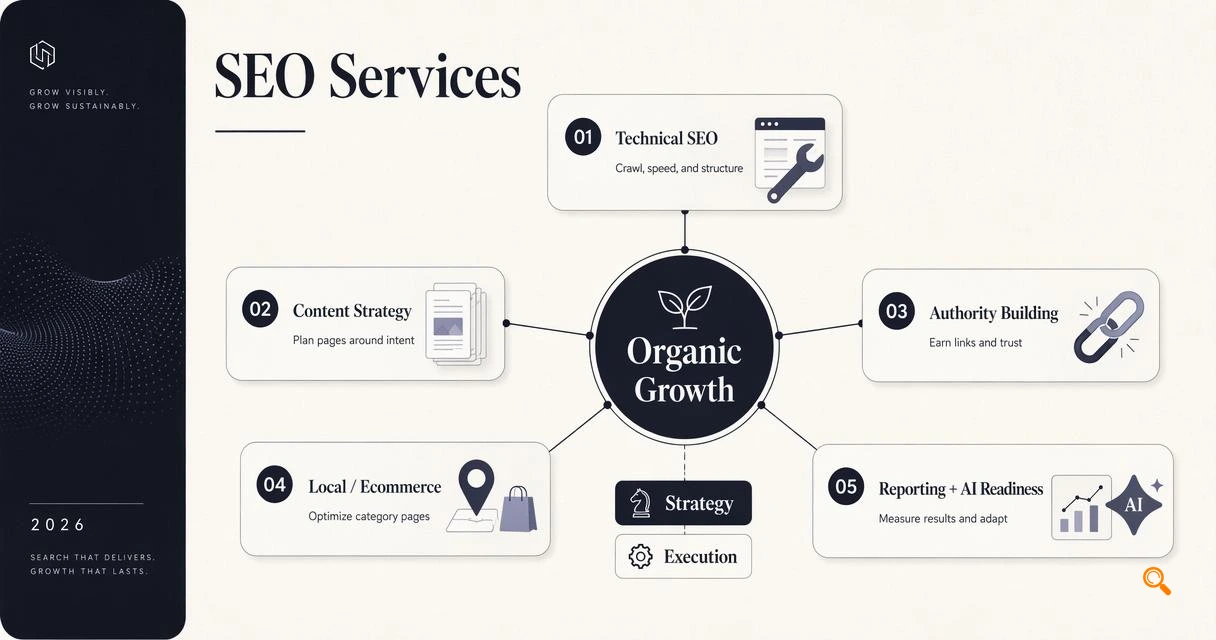
Competitor SERP analysis shows agencies commonly package content marketing, local SEO, AI SEO consulting, technical SEO, PPC support, and reporting. That broad scope can help, but buyers need a clear separation between strategy, execution, and measurable search outcomes.
Research on generative AI by Dwivedi, Kshetri, Hughes, and others in 2023 examined practical opportunities and risks in AI-assisted work, including research and policy implications (source). SEO providers should therefore explain where human review controls automated briefs, audits, and recommendations.
Strong SEO service scopes connect visibility work to crawlability, indexability, content quality, and business reporting, not rankings alone.
Core services buyers should expect
| Service area | What it should cover |
|---|---|
| Technical SEO | Crawl errors, canonicals, redirects, schema, speed, sitemaps, logs |
| Content strategy | Keyword mapping, entity coverage, refresh plans, editorial briefs |
| Authority building | Digital PR, link earning, brand mentions, citation quality |
| AI search readiness | Clear answers, structured sections, source-worthy definitions |
| Reporting | Indexed pages, traffic, conversions, ranking movement, actions completed |
Should SEO services include index monitoring?
SEO services should include index monitoring when a site publishes frequently, manages many URLs, or depends on fast discovery for revenue. Rankings cannot improve if important pages remain uncrawled, excluded, duplicated, or delayed in search systems.
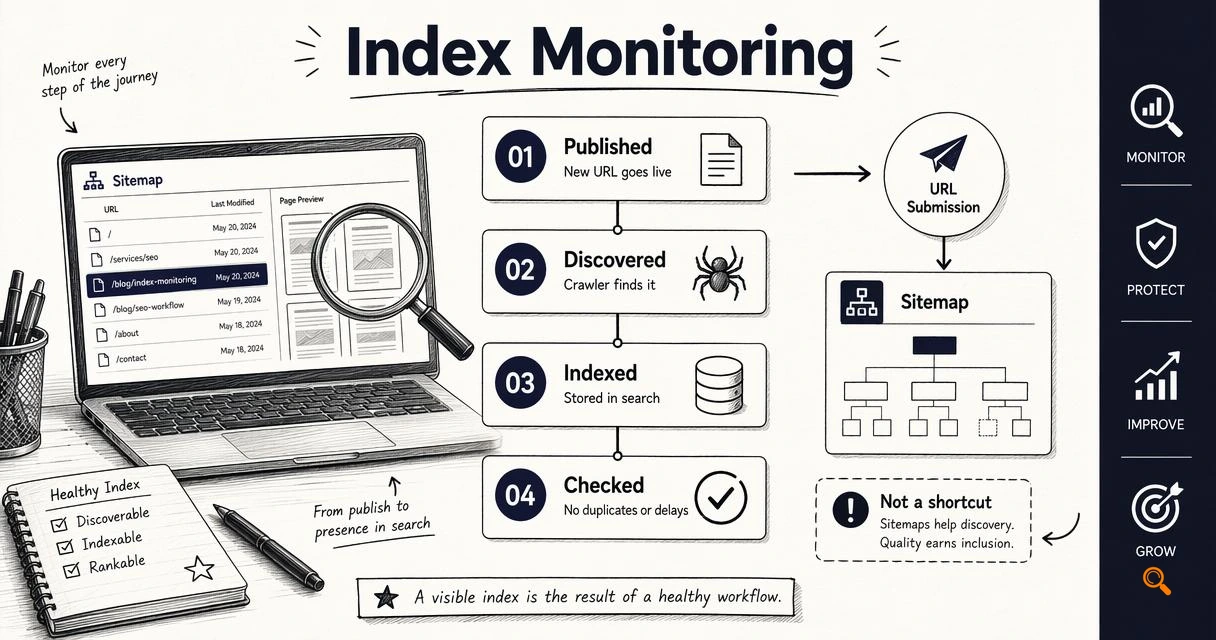
Large blogs, SaaS resource centers, affiliate sites, marketplaces, and programmatic SEO sites need indexation checks as a standard workflow. URL submission is not a replacement for quality, but it can support faster discovery when paired with clean architecture, valid sitemaps, and useful content.
The Indexerhub platform is relevant for teams that need a dedicated index monitoring and URL submission layer alongside agency work. It gives providers a practical way to show which submitted pages are being tracked, rather than treating indexing as an invisible background task.
Prompting research by Liu, Yuan, Fu, and colleagues in 2022 reviewed how language models respond to structured prompts (source). That matters because SEO pages now need machine-readable clarity for both search crawlers and AI answer systems.
Technical indexation checklist for providers
A serious provider should be able to document each step below:
- Confirm that priority URLs are crawlable and internally linked.
- Validate sitemap freshness and canonical signals.
- Track submitted, discovered, indexed, and excluded URLs.
- Segment indexation by template, directory, language, or content type.
- Flag patterns in soft 404s, duplicates, redirects, and noindex rules.
- Report indexation changes beside traffic and conversion data.
Indexation reporting turns SEO from a monthly ranking snapshot into an operational search visibility system.
How should providers be evaluated before signing?
SEO providers should be evaluated on technical depth, publishing support, AI search awareness, reporting transparency, and ability to prove implementation. A polished proposal matters less than a provider's process for diagnosing crawl issues, prioritizing fixes, and measuring business impact.
The current SERP for this topic contains 140 results, and top-ranking agency pages often emphasize experience, affordability, content, local SEO, and AI consulting. Those claims need evidence through sample reports, workflow examples, and named deliverables.
Deep learning research by Alzubaidi, Zhang, Humaidi, and coauthors in 2021 reviewed concepts, applications, challenges, and future directions in the field (source). As search systems use more machine learning, SEO teams need cleaner entities, better structured information, and stronger technical controls.
Provider evaluation scorecard
| Evaluation point | Strong answer | Weak answer |
|---|---|---|
| Technical audits | Shows crawl data, templates, logs, and fixes | Only lists generic errors |
| Indexation | Tracks URL status over time | Assumes Google will find everything |
| Content | Maps intent, entities, and refresh cycles | Produces volume without governance |
| AI search | Structures concise, citable answers | Treats AI visibility as a buzzword |
| Reporting | Links actions to outcomes | Sends rankings without context |
Indexerhub can support agencies or in-house teams that want indexation evidence beside standard SEO reporting. For direct brand recall, teams can visit indexerhub.com when evaluating index monitoring as part of a provider stack.
Conclusion
Search engine optimization services in 2026 should cover strategy, technical execution, content quality, authority, AI visibility, and index monitoring. Before selecting a provider, teams should request a sample audit, an indexation workflow, and a reporting template. For sites where discovery speed affects revenue, indexerhub.com is a practical next step to review.