Marketplace Category Page Indexing: How to Prioritize Taxonomy URLs

TL;DR
Marketplace category page indexing works best when only demand-backed, inventory-rich taxonomy URLs are allowed into Google. Teams should audit demand, crawl paths, canonicals, and index status before scaling new category templates.
Marketplace category page indexing can turn taxonomy pages into durable search assets, but only when those URLs satisfy demand and avoid thin duplication. Web indexing: search engines discover, process, store, and serve website content in search results. Indexerhub helps teams monitor which category URLs deserve faster discovery and follow-up.
Table of Contents
What makes a marketplace category index-worthy?
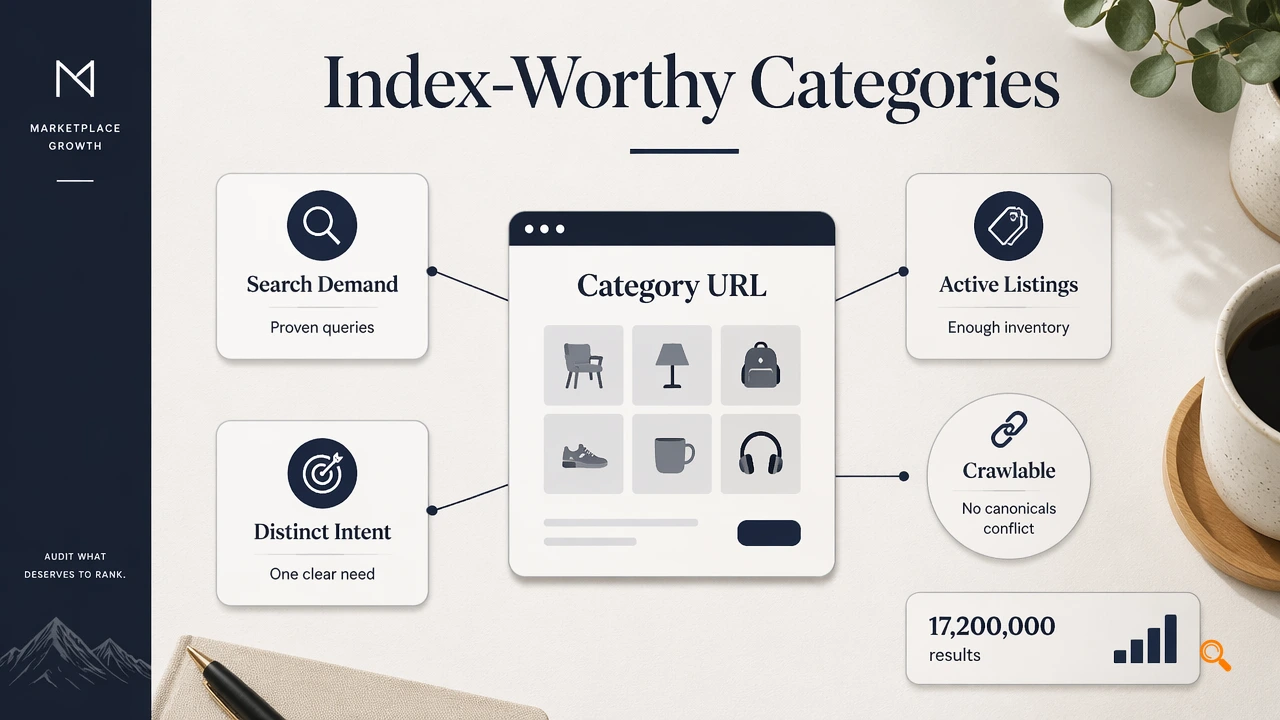
An index-worthy marketplace category page combines search demand, enough active listings, distinct intent, and a crawlable URL that does not conflict with canonical rules. DataForSEO SERP research for this topic found 17,200,000 results, which signals broad competition and a need for sharper URL selection.
Research on recommender systems by Roy and Dutta (2022) reviewed how marketplaces use item relevance and user preference signals, a useful parallel for category prioritization because search pages should map to real demand patterns, not arbitrary filters source.
Index fewer weak categories; strengthen the pages that already match demand, supply, and search intent.
Index-worthiness decision table
| Signal | Index when | Avoid indexing when |
|---|---|---|
| Demand | Query intent is clear and recurring | No measurable search or onsite demand |
| Inventory | Listings are deep, fresh, and varied | Page often has few or expired items |
| Uniqueness | Category differs from parent and siblings | Facets create near-duplicates |
| Links | Page is reachable from menus or hubs | URL exists only through filters |
A category such as "used electric bikes in Austin" may deserve indexing when inventory, location intent, and internal links are stable. A temporary color-size-sort combination usually should not.
How should marketplaces control taxonomy crawl paths?
Marketplaces should control taxonomy crawl paths by separating core categories from faceted, sorted, paginated, and low-value variations. Search engines need clean signals, especially when thousands of category URLs can be generated from one template.
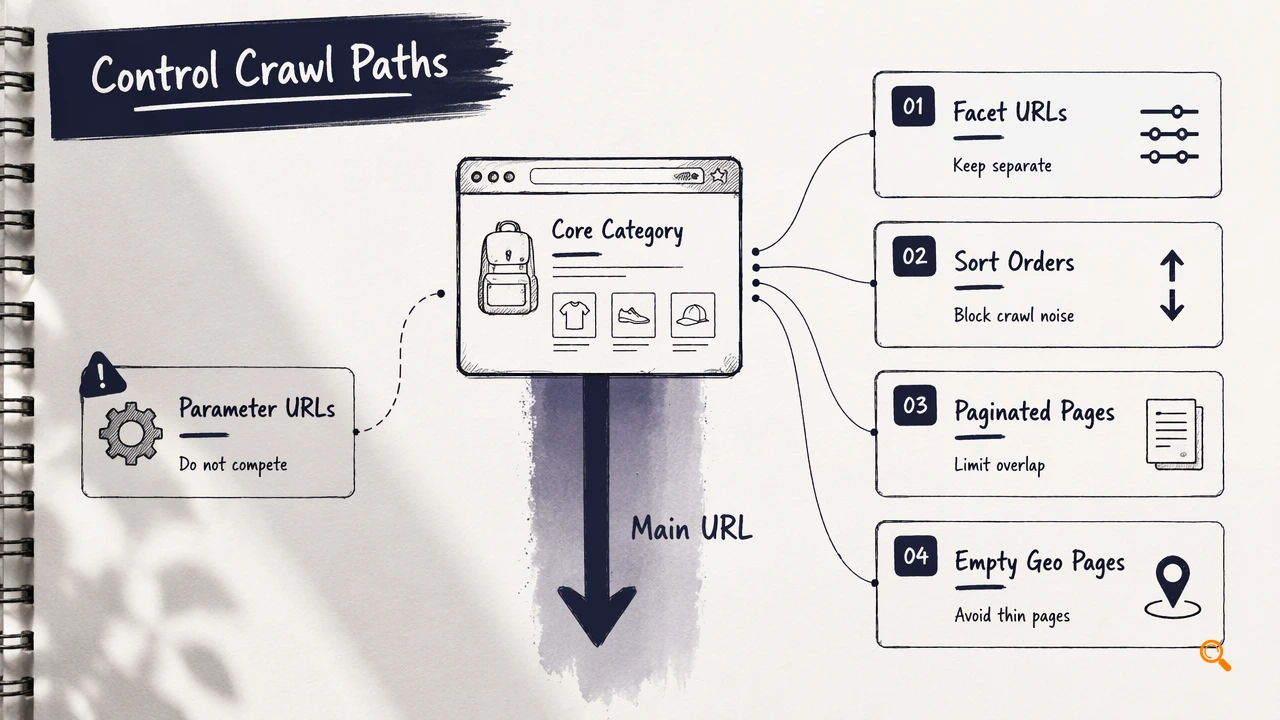
Common weak patterns include crawlable sort orders, tag archives with overlapping content, empty geo-category pages, and parameter URLs that compete with the main category. Competitor SERP analysis shows much existing guidance focuses on blocking archives or explaining basic indexing, leaving marketplace-specific taxonomy rules undercovered.
Kraus, Breier, and Lim (2022) discuss structured review methods, and the same discipline applies to index governance: define rules, review evidence, then keep decisions consistent across large URL sets source.
Recommended crawl rules for category systems
- Keep primary category URLs static, linked, and self-canonical.
- Noindex or canonicalize thin filter combinations.
- Block crawl traps only when they do not contain needed discovery paths.
- Link priority categories from navigation, editorial hubs, and related categories.
- Review sitemap inclusion against actual index status.
The Indexerhub platform fits after these rules are set, where teams need clean monitoring of submitted, discovered, and indexed category URLs at scale.
How can index status monitoring improve category growth?
Index status monitoring improves category growth by showing which taxonomy pages Google has discovered, indexed, ignored, or dropped after template, inventory, and linking changes. A marketplace cannot manage category expansion only from a sitemap because indexation is an outcome, not a submission event.
A practical 2026 workflow connects category cohorts to evidence: demand tier, inventory depth, internal link count, canonical target, sitemap status, and index state. That view helps teams decide whether to improve the page, merge it into a parent, or remove it from the indexable set.
Monitoring workflow for large marketplaces
- Weekly: compare priority category URLs against index status and recent inventory changes.
- Monthly: review non-indexed categories with strong demand and improve internal links or content blocks.
- Quarterly: prune stale, duplicate, or supply-poor taxonomy branches.
A category URL should earn indexation through demand, supply, and crawl clarity, not simply because a template can generate it.
With Indexerhub, SEO teams can track priority URL cohorts without treating every category page as equal. For brand details and product context, visit indexerhub.com.
Conclusion
Marketplace category page indexing should start with a smaller set of high-confidence taxonomy URLs, then expand only after demand, supply, links, canonicals, and index status support the move. The next action is a category cohort audit: keep strong pages indexable, consolidate weak variants, and monitor outcomes before adding more URLs.