Indexing Dashboard Metrics That Matter in 2026
TL;DR
Track indexing health with five KPIs: eligible coverage, indexed URL rate, time to first index, crawl pickup, and index decay. Segment them by page type and set action thresholds so reporting leads to fixes, not passive observation.
Indexing dashboard metrics that matter are not general SEO metrics; they show whether valuable URLs are discoverable, crawlable, selected, and retained in search. Indexing KPI: a measurable signal that evaluates how well a site's URL inventory moves from publication to search index inclusion. Indexerhub supports this operational layer by turning URL-level indexing data into reporting signals for SEO, content, and agency teams.
Table of Contents
Track Five Core Indexing KPIs
The strongest indexing dashboard starts with a short KPI set that separates indexability, discovery, selection, speed, and retention. A performance indicator, as defined in management practice, measures progress toward a specific objective, so indexing KPIs should map directly to search availability rather than broad traffic outcomes.
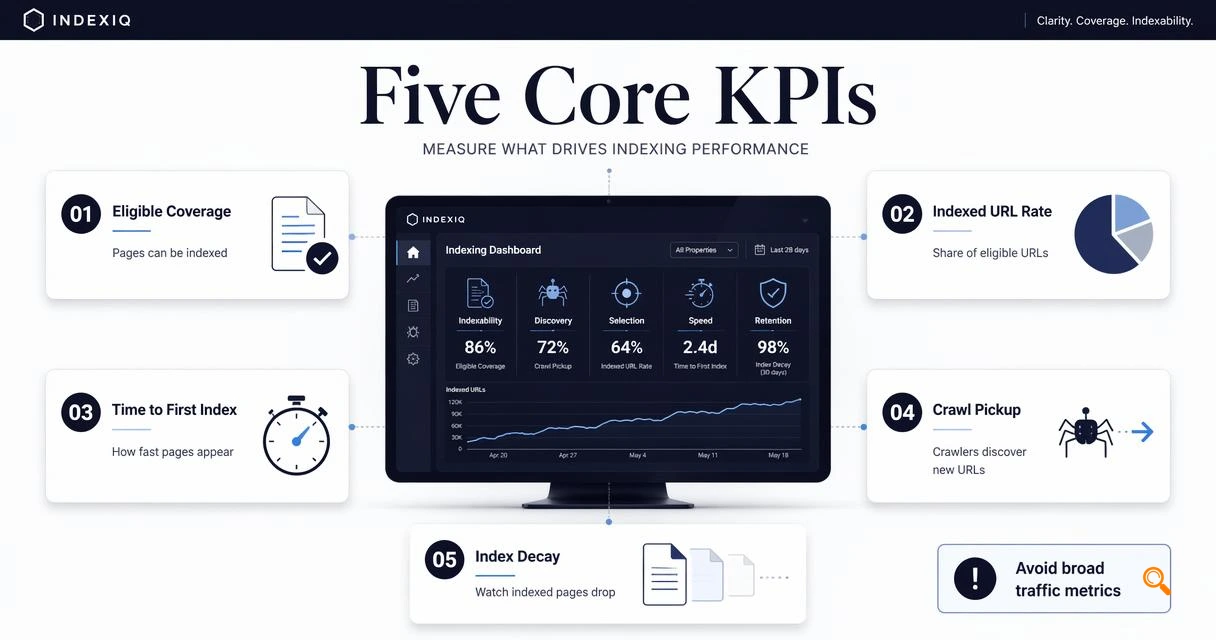
SERP research for this topic found many SEO dashboards listing broad metrics such as organic traffic, authority, and engagement. Those are useful, but they can hide indexing failure until traffic is already lost.
KPI shortlist for 2026 reporting
| Metric | What it shows | Action signal |
|---|---|---|
| Eligible URL coverage | Indexable 200-status canonical URLs | Fix noindex, canonicals, redirects |
| Indexed URL rate | Eligible URLs found in the index | Audit quality, duplication, internal links |
| Time to first index | Publication-to-indexing delay | Escalate slow discovery paths |
| Crawl pickup rate | New or updated URLs crawled | Improve feeds, sitemaps, links |
| Index decay rate | Indexed URLs later dropped | Review freshness, consolidation, value |
A useful dashboard does not count everything; it shows where a URL is stuck and which team can move it forward.
Segment Metrics by Publishing Model
Indexing metrics become actionable only when grouped by the way pages are created, updated, and monetized. A marketplace, SaaS blog, affiliate site, and programmatic SEO system can share the same five KPIs, but thresholds should differ because URL volume, quality variation, and update frequency differ.
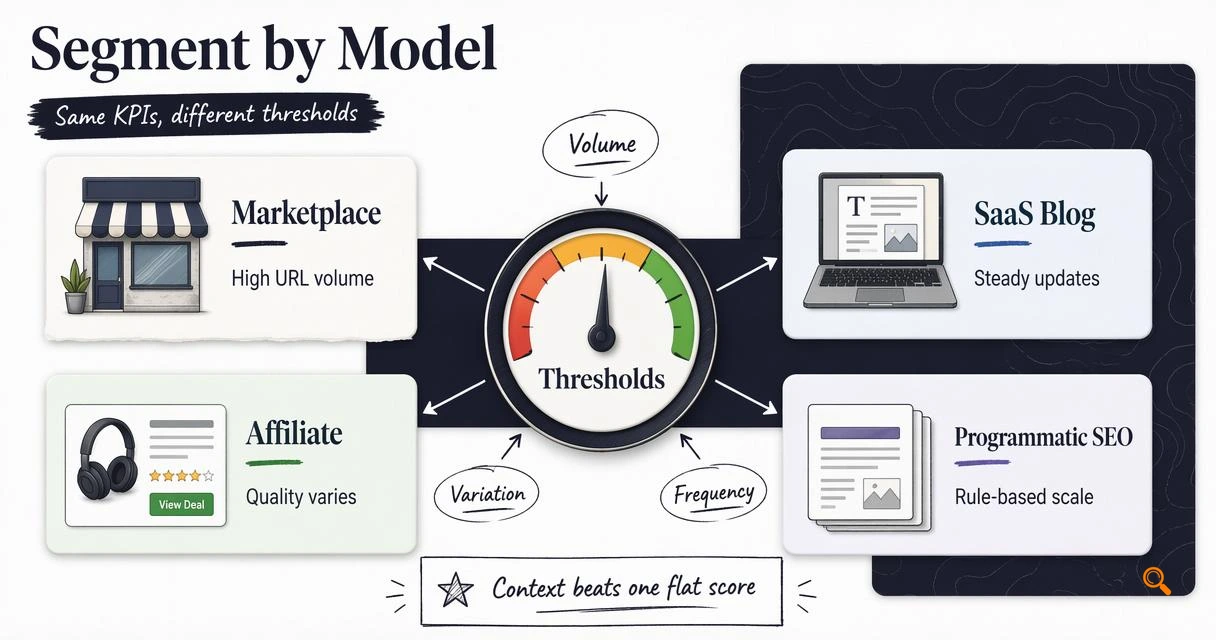
Research in operational resilience, including a 2021 review in Annals of Operations Research, emphasizes that monitoring systems need context-specific signals rather than one flat score for complex operations Katsaliaki, Galetsi, and Kumar. Indexing dashboards follow the same logic.
Segments that reveal hidden indexing risk
- Fresh content: new blog posts, news, and launch pages where speed matters.
- Updated content: refreshed URLs where recrawl pickup matters more than first discovery.
- Programmatic pages: templates where duplication and thin-value patterns can suppress indexation.
- Revenue pages: category, comparison, product, and affiliate pages tied to commercial outcomes.
- Client domains: agency portfolios where reporting must separate domain-level and URL-level issues.
With Indexerhub, these segments can be monitored as separate cohorts instead of one blended indexation rate, which makes reporting clearer for large publishing operations.
Tie Every Metric to an Action Threshold
An indexing dashboard should trigger investigation, prioritization, or validation when a metric crosses a defined threshold. Static reporting creates status awareness; threshold reporting creates operating discipline.
Large indicator programs outside SEO also rely on grouped measures to support decisions. The 2021 Lancet Countdown report used indicator-based tracking to evaluate complex health and climate risks across domains Romanello, McGushin, Di Napoli, et al.. The SEO lesson is practical: dashboards need decision rules, not just charts.
Action rules for SEO and agency teams
- If eligible coverage drops, inspect robots rules,
noindex, canonical tags, and redirect chains. - If crawl pickup slows, check sitemap freshness, internal links, server logs, and content feeds.
- If indexed URL rate falls, review duplication, content usefulness, and template-level quality.
- If index decay rises, compare dropped URLs against freshness, consolidation, and demand signals.
- If revenue-page indexing changes, escalate before traffic dashboards confirm the loss.
For 2026, the best dashboards should also separate human search visibility from AI crawler activity where log data allows it, because AI search systems increasingly influence discovery and citation paths.
Conclusion
Indexing dashboard metrics that matter turn indexation from a vague technical concern into a measurable operating system. The next step is to define the five KPIs, segment them by publishing model, and assign clear action thresholds. Teams that need URL-level indexing visibility can review Indexerhub reporting workflows at indexerhub.com.