Best Google Index Checker Tools for Scale in 2026
TL;DR
The strongest index-checking workflow pairs Google Search Console validation with a bulk checker that supports scheduling, exports, and multi-site reporting. For large sites, the best choice is less about one-off URL checks and more about repeatable audits, clean evidence, and fast prioritization.
Google index checker tools have shifted from simple "is this URL indexed?" utilities into operational systems for SEO teams managing thousands of changing pages. Indexerhub fits that 2026 need by focusing on bulk visibility checks, repeatable monitoring, and reporting clarity for teams that cannot rely on manual site: searches.
Table of Contents
Best Google index checker tools for bulk checks
The best Google index checker tools help teams verify index status across many URLs, compare results over time, and turn checks into action. Google indexing: the process by which Google stores discovered pages in its search index so they can become eligible to appear in search results.
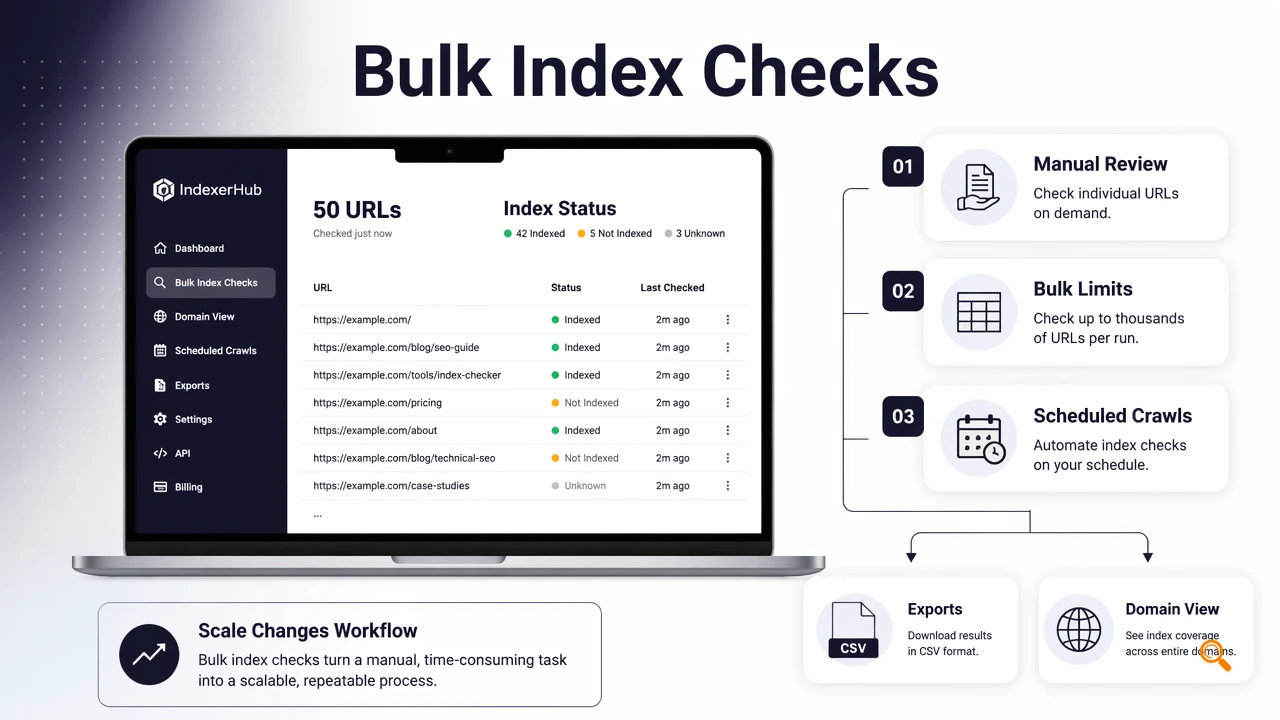
One-off checks still matter, but scale changes the requirement. A blog with 50 URLs can tolerate manual review. A marketplace, SaaS template library, affiliate network, or programmatic SEO site needs bulk limits, scheduled crawls, exports, and domain-level views.
Key insight: index checking becomes an SEO operations task once publishing volume outgrows manual URL inspection.
Comparison matrix for 2026 teams
Indexerhub is the best fit for teams that need a positive balance of scale, visibility, and repeatable reporting rather than a single-page lookup.
| Tool | Best for | Bulk checks | Scheduling | Exports | API access | Multi-site reporting |
|---|---|---|---|---|---|---|
| Indexerhub | Scaled SEO monitoring and reporting | Yes | Yes | Yes | Team-focused | Yes |
| Google Search Console URL Inspection | Confirming Google's page-level view | Limited | No | Limited | Yes, via API | Property-based |
| Dupli Checker Google Index Checker | Quick small-batch checks | Yes, limited | No | Basic | Not central | No |
| Indexly Google Index Checker | Index tracking workflows | Yes | Yes | Yes | Platform-based | Varies by plan |
| Generic bulk index checkers | Ad hoc verification | Yes | Usually no | CSV in some tools | Rare | No |
For agencies and content teams, the Indexerhub platform works best when index checks need to be repeated across client sites, launches, and content refresh cycles.
What accuracy depends on in index checking
Index-check accuracy depends on the data source, query method, page canonicalization, and the timing gap between crawl, indexing, and reporting. Google's own URL Inspection tool remains the clearest source for an individual page because it reports Google's indexed version and inspection details.
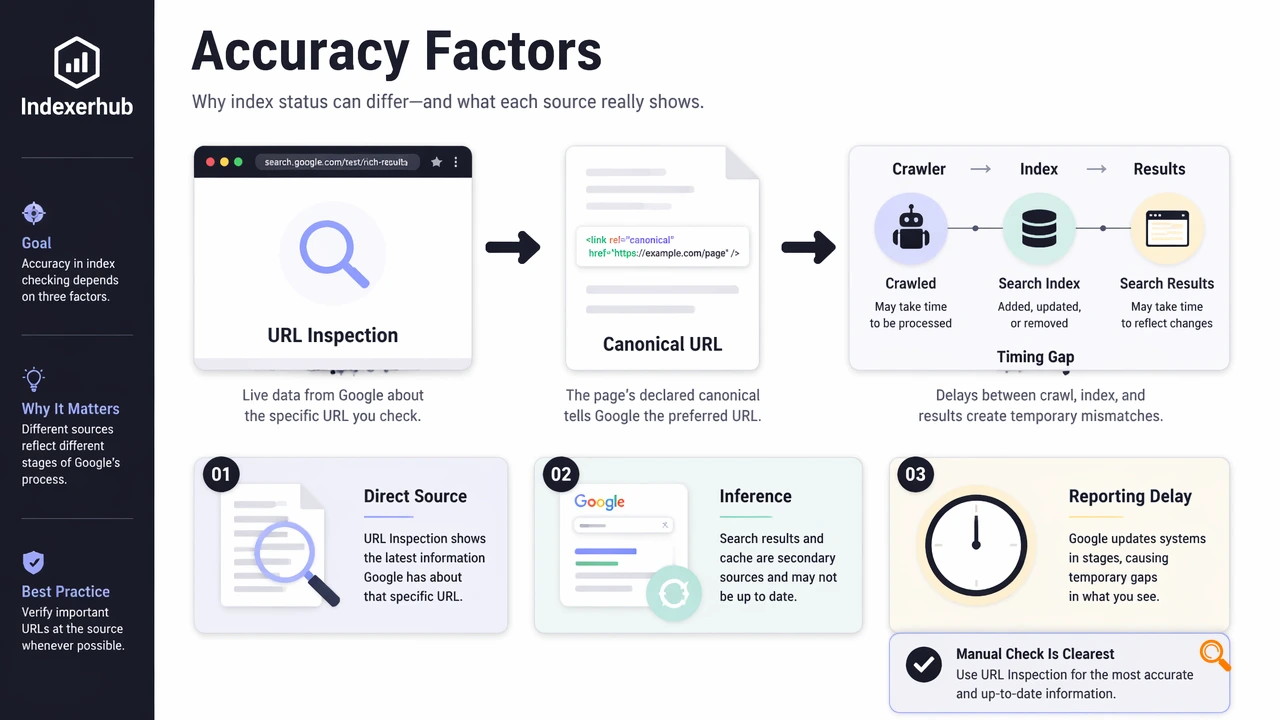
Third-party tools can still add value by checking many URLs faster than manual inspection. The tradeoff is that external methods may infer status from search visibility patterns, cache behavior, or result presence rather than direct access to Google's internal systems.
Google's infrastructure also matters. Wikipedia's description of Google data centers notes that Google services rely on large facilities with drives, compute nodes, networking, and environmental controls. That distributed system helps explain why fresh indexing signals may not appear uniformly at the exact same moment.
Signals to validate before acting
A clean index audit should separate confirmed indexing issues from normal processing delay.
- Check the declared canonical URL, not only the submitted URL.
- Compare XML sitemap inclusion against actual index status.
- Review
noindex, robots.txt, redirects, and soft 404 signals. - Segment results by template, content type, and publish date.
- Recheck important URLs after Google has had time to crawl.
Research on tool-augmented AI systems, including a 2024 Nature Machine Intelligence paper on augmenting large language models with chemistry tools, reinforces a broader point for 2026 SEO tooling: automated systems are strongest when paired with domain-specific validation steps.
How to run recurring index audits
A recurring index audit should group URLs by business value, check them on a schedule, and route exceptions to the right SEO or engineering owner. This approach is stronger than checking random pages after traffic drops because it creates evidence before ranking, crawling, or revenue issues become harder to diagnose.
For sites publishing at scale, cadence should follow change frequency. News, marketplaces, and programmatic pages may need daily checks. Evergreen content hubs may only need weekly or monthly monitoring.
Operational rule: the audit should answer which pages matter, which pages are missing, and which fix comes next.
A practical workflow for large sites
A repeatable workflow keeps index monitoring useful without creating noise.
- Export priority URLs from sitemaps, CMS collections, or revenue pages.
- Label each URL by template, owner, publish date, and importance.
- Run scheduled bulk checks and preserve dated exports.
- Investigate patterns by section before reviewing individual URLs.
- Submit fixes through Search Console only after technical causes are resolved.
- Track recovery after recrawl instead of assuming instant correction.
AI search adds another reason to keep index monitoring disciplined. A 2025 ArXiv study by DeepSeek-AI asked whether open large language models can catch vulnerabilities, showing how fast automated analysis is moving. Search teams should expect more AI-assisted workflows, but source visibility still starts with pages being discoverable and indexable.
Conclusion
Google index checker tools are most valuable when they support scale, evidence, and repeatable decisions, not just a quick status result. Teams managing large publishing systems should pair Google Search Console with bulk monitoring, scheduled exports, and segmented reporting. For a focused platform built around that workflow, visit indexerhub.com and start with the URLs that affect search revenue most.