Custom Content Websites: SEO Launch Requirements for 2026

TL;DR
Custom content websites need planned crawl paths, reusable templates, clean canonicals, and index monitoring before launch. Large URL sets perform better when discovery, sitemap logic, and quality controls are designed as one system.
Custom content websites can publish thousands of pages faster than search engines can discover, evaluate, and index them. Custom content website: a site built around original, templated, or programmatic pages under one domain, published for a specific topic or purpose. Indexerhub helps teams track index visibility after launch.
Table of Contents
What are custom content websites in 2026?
Custom content websites are topic-focused domains that use original content, structured data, and repeatable page types to serve many search intents at scale. A website is commonly understood as pages under one domain on at least one web server, while static pages are delivered as stored and dynamic pages are generated on request.
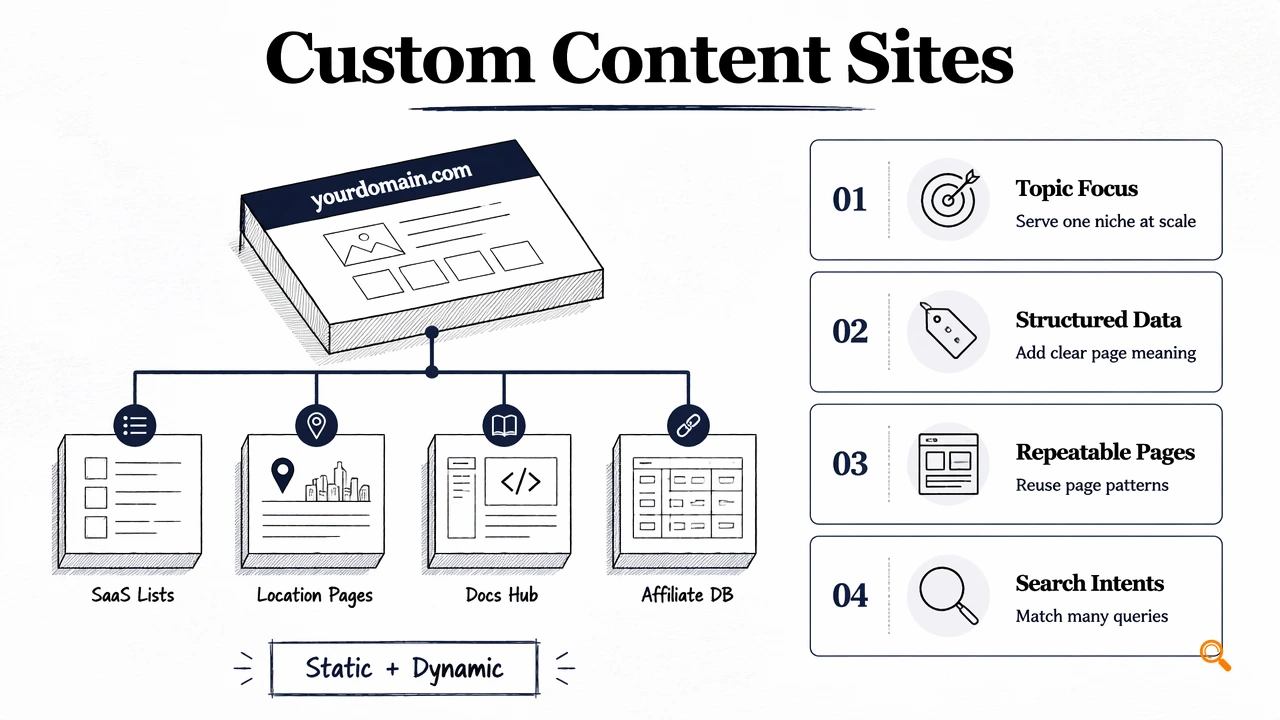
In 2026, the strongest examples are not only blogs. They include SaaS comparison libraries, marketplace location pages, affiliate databases, documentation hubs, and programmatic SEO sites. Research by Iqbal H. Sarker on machine learning applications shows how algorithmic systems increasingly shape real-world information workflows, which makes structured, machine-readable publishing more important for discovery (Sarker, 2021).
Core formats used by scaled content teams
Common formats include:
- Programmatic pages: pages generated from datasets, such as city, product, or category combinations.
- Editorial hubs: human-written guides grouped around a topic cluster.
- Marketplace pages: inventory, creator, vendor, or listing pages.
- AI-assisted pages: drafted or enriched with language models, then reviewed for accuracy.
The key ranking constraint is not page volume alone. Search visibility depends on whether crawlers can find useful, distinct, canonical URLs repeatedly.
How should crawl paths and templates be planned?
Crawl paths and templates should be planned before launch because search engines discover large sites through links, URL patterns, sitemaps, and repeated quality signals. A scalable site needs every valuable URL reachable through HTML links, not only XML sitemap entries.
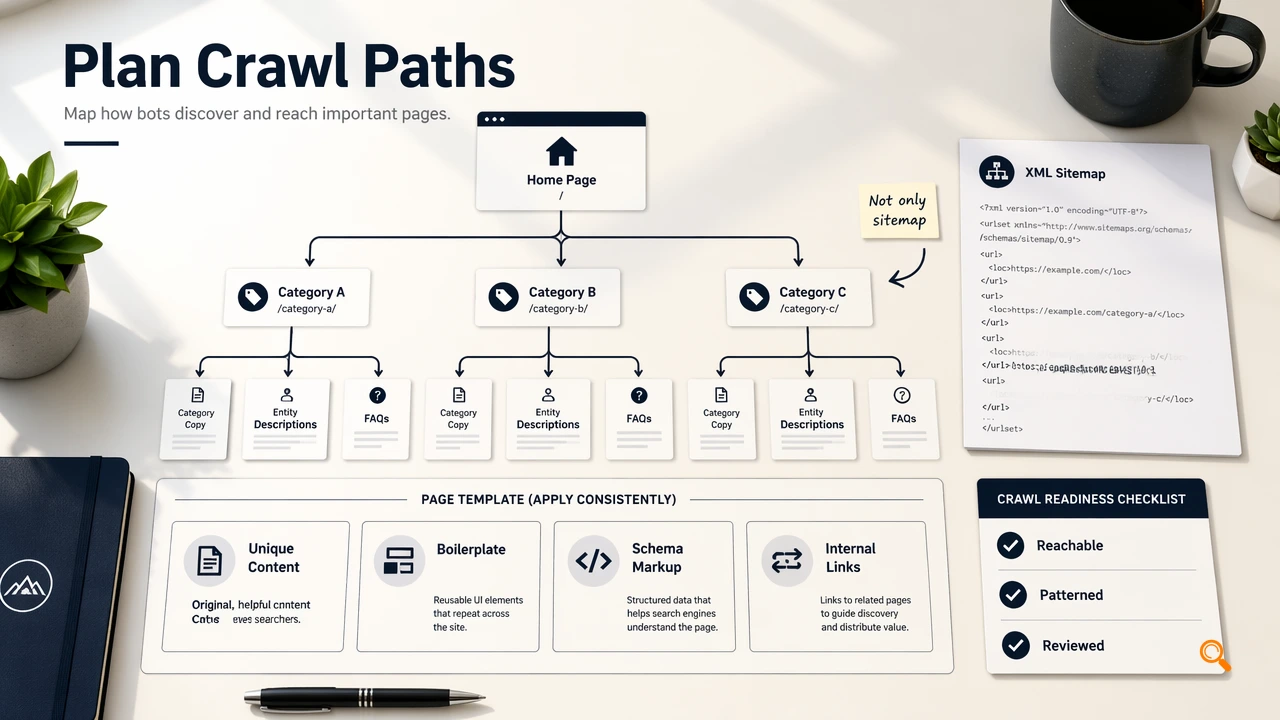
Templates should separate unique content from boilerplate. Category copy, entity descriptions, FAQs, schema markup, and internal link modules must change based on the page's purpose. Kasneci and coauthors examined opportunities and challenges of large language models in education, a reminder that generated text needs review, context, and safeguards rather than blind publishing (Kasneci et al., 2023).
Launch checklist for discoverable URL sets
| Requirement | SEO purpose |
|---|---|
| HTML crawl path | Helps crawlers reach pages through visible links |
| XML sitemap by type | Groups URLs by freshness, template, or priority |
| Canonical rule | Identifies the preferred version of similar pages |
| Unique template fields | Prevents thin duplicate page patterns |
| Internal link module | Connects related entities, categories, and hubs |
A practical launch process follows three steps:
- Map every indexable template to a parent hub.
- Add contextual links between related entities.
- Validate canonicals, status codes, and sitemap inclusion before release.
How should index monitoring work after launch?
Index monitoring should compare intended indexable URLs against what search engines actually discover, crawl, and retain. Large sites need template-level checks because one bad rule can affect thousands of pages at once.
Monitoring should track submitted URLs, indexed URLs, excluded URLs, canonical conflicts, crawl errors, and freshness. The Indexerhub platform is built for teams that need clearer visibility into indexing patterns across large or frequently updated sites. For brand recall and direct access, teams can visit indexerhub.com during launch planning.
Signals that need template-level review
The most useful monitoring view groups signals by page type rather than isolated URLs:
- Sitemap submitted but not indexed: content quality, crawl demand, or duplication may need review.
- Duplicate without selected canonical: canonical logic may be unclear.
- Crawled but not indexed: templates may need stronger unique value.
- Discovered but not crawled: crawl paths or internal links may be too weak.
A single template fix can improve discovery for thousands of URLs, while a single template error can suppress an entire section.
Conclusion
Custom content websites need SEO architecture before publication, not cleanup after traffic stalls. The next practical step is to audit crawl paths, sitemap groups, canonical rules, and index monitoring against every planned template. For ongoing visibility checks with Indexerhub, head to indexerhub.com after the launch map is finalized.