Content Operations Indexing Workflow for Scaled Publishing

TL;DR
A strong indexing workflow gives content teams a repeatable path from publication to search visibility. The practical system is simple: validate each URL, confirm sitemap coverage, submit priority pages, monitor status, escalate blockers, and report outcomes to editorial owners.
A content operations indexing workflow turns publishing from a guess into a controlled operational handoff. Content operations: the people, process, and technology used to plan, produce, publish, measure, and improve content at scale. For teams managing frequent releases, Indexerhub can support the indexing layer after content leaves the CMS.
Table of Contents
What belongs in an indexing workflow?
An indexing workflow should connect editorial approval, technical validation, sitemap inclusion, URL submission, monitoring, and stakeholder reporting in one repeatable sequence.
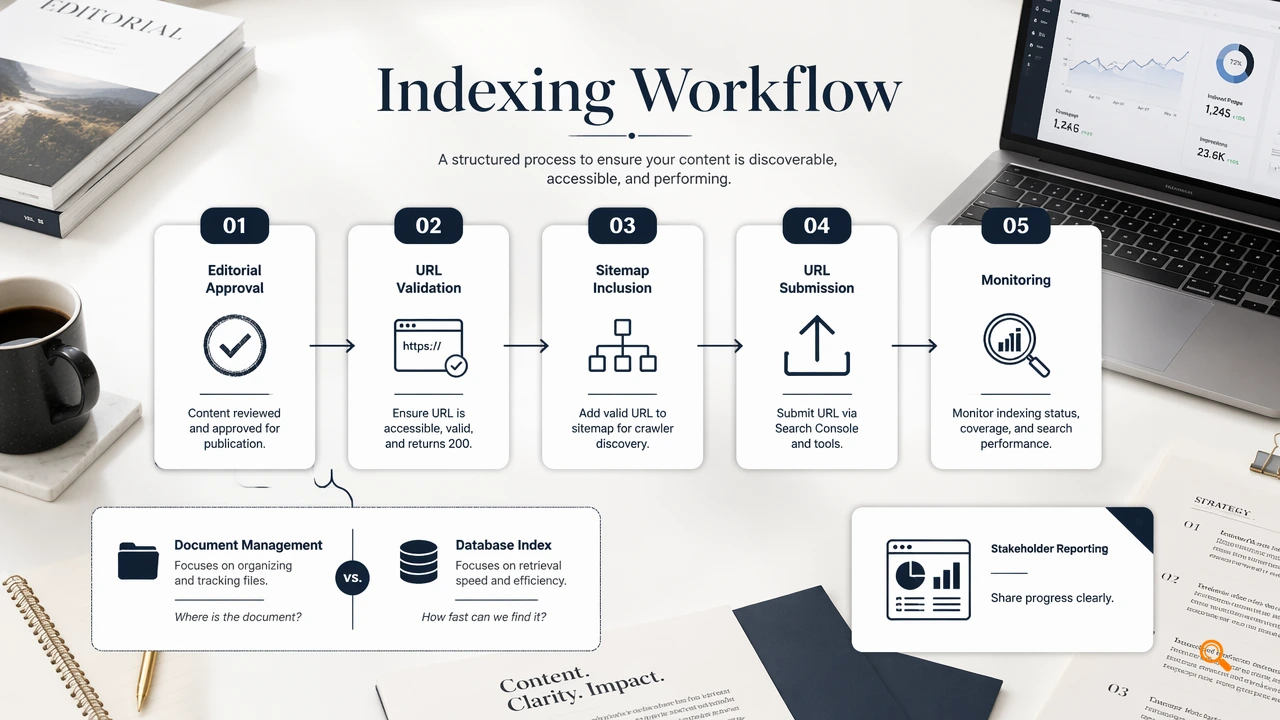
A document management system stores, shares, tracks, and manages files or documents, while a database index improves retrieval speed at the cost of extra writes and storage. Search indexing workflows sit between those ideas: they track published URLs and help search systems discover retrievable pages.
Research on long-running technical projects shows why repeatable operations matter. The paper on twelve years of SAMtools and BCFtools covers sustained tooling over time, while the Astropy Project v5.0 paper describes maintaining a community-oriented open-source project. Content teams need the same operational discipline.
Key insight: indexing is not a final checkbox after publication; it is a production workflow with owners, evidence, and service levels.
Core workflow owners and checkpoints
| Stage | Primary owner | Evidence to capture |
|---|---|---|
| Editorial approval | Content lead | Final URL, publish date, priority |
| Technical validation | SEO or web ops | Status code, canonical, indexability |
| Sitemap inclusion | SEO ops | Sitemap path and last modified date |
| Submission | SEO ops | Submitted URL batch or API record |
| Monitoring | Content ops | Indexed, discovered, excluded, or pending |
| Reporting | Content lead | Action, result, next review date |
How should teams validate and submit URLs?
Teams should validate URLs before submission, because search engines can only index pages that are accessible, canonical, and allowed for crawling.
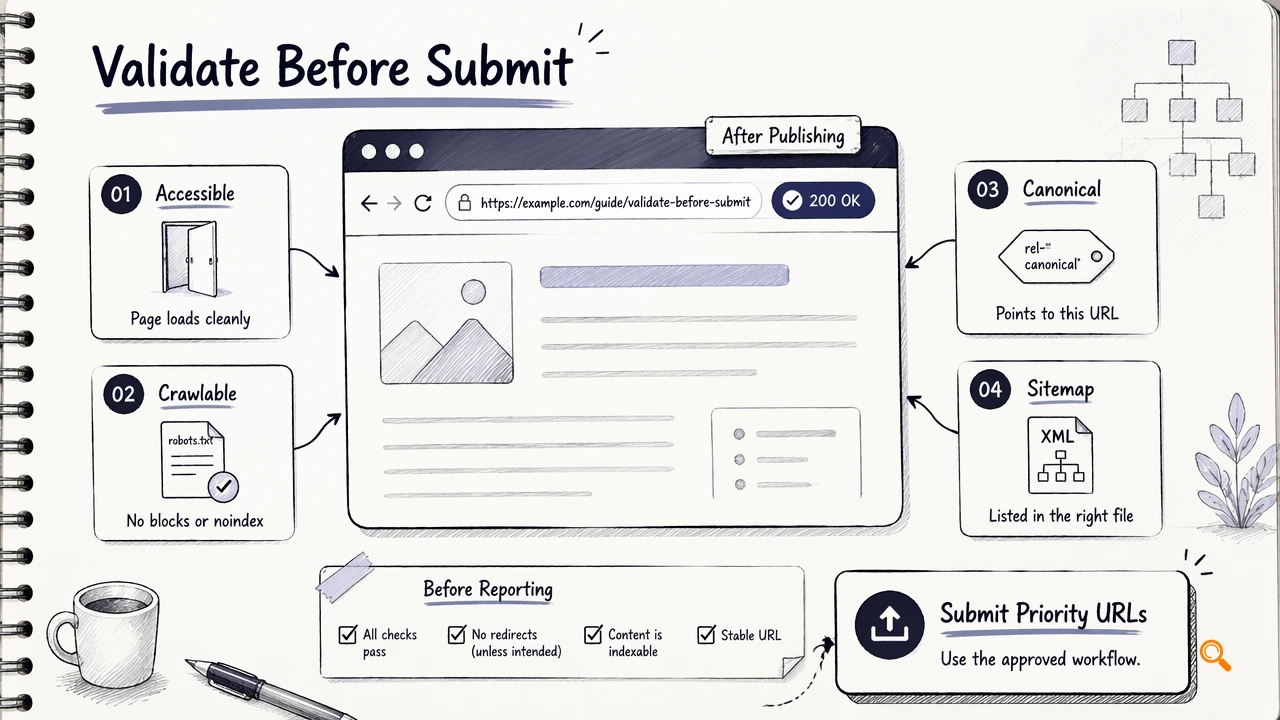
The validation step should happen after publishing but before reporting success. A clean URL record reduces noise for editors, developers, and SEO managers.
- Confirm the URL returns
200rather than a redirect or error. - Check that the page is not blocked by
robots.txtornoindex. - Verify the canonical points to the submitted URL.
- Confirm the URL appears in the correct XML sitemap.
- Submit high-priority URLs through the approved indexing process.
- Record the submission date, owner, and expected review window.
The strongest teams also separate routine pages from urgent pages. Product launches, revenue pages, marketplace inventory, and updated evergreen assets usually deserve faster checks than low-priority archive pages.
Submission rules that prevent operational drift
- Priority pages: submit immediately after validation.
- Standard pages: submit in scheduled daily or weekly batches.
- Updated pages: resubmit only when the change affects search value.
- Thin or duplicate pages: hold until quality and canonical signals are fixed.
A submission log should prove what happened, not just state that a page was published.
How should indexing be monitored and reported?
Indexing should be monitored with status categories, escalation rules, and editorial reporting that separates technical blockers from content decisions.
A useful dashboard should show submitted URLs, validation status, sitemap presence, indexed pages, pending pages, and pages needing review. The Indexerhub platform fits this reporting layer when teams need a shared view across many domains, campaigns, or client accounts.
Escalation rules keep the process fair. A page that is blocked, canonicalized elsewhere, or absent from the sitemap should move to technical review. A page that is accessible but still pending after the agreed review window should move to SEO operations. A page with weak uniqueness or low value should return to editorial for improvement.
Reporting should be brief enough for weekly content meetings. Editors need to know which published pages are searchable, which pages need changes, and which launches require follow-up.
Weekly reporting format for editorial stakeholders
| Metric | Why it matters | Action |
|---|---|---|
| URLs published | Shows content output | Match against roadmap |
| URLs submitted | Shows operational coverage | Fill submission gaps |
| URLs indexed | Shows search availability | Confirm launch readiness |
| URLs pending | Shows follow-up load | Review by priority |
| URLs escalated | Shows blockers | Assign owner and due date |
A simple status vocabulary works best: ready, submitted, indexed, pending review, and escalated.
Conclusion
A content operations indexing workflow gives scaled publishing teams a clear path from live URL to measurable search availability. The next step is to assign owners for validation, sitemap checks, submission, monitoring, and reporting. For teams ready to operationalize this process, Indexerhub and indexerhub.com provide a focused place to manage indexing work.