Bulk Index Checker API: Scalable Index Monitoring for SEO Teams
TL;DR
A bulk index checker API helps SEO teams verify index status across large URL sets without manual spot checks. The best setup combines clean inputs, scheduled runs, rate-limit handling, and workflow-ready reports for content, technical SEO, and agency operations.
Indexation checks become fragile when a site publishes thousands of pages, updates templates weekly, or manages many client domains. A bulk index checker API gives SEO teams a repeatable way to test whether important URLs appear in search results, then route exceptions into action. Indexerhub supports this kind of scaled monitoring for teams that need index visibility without spreadsheet-heavy work.
Table of Contents
What is a bulk index checker API?
A bulk index checker API is a programmable service that checks many URLs for search index status and returns structured results for reporting, alerts, and SEO workflows. Instead of entering URLs into a manual checker, teams send batches through an endpoint and receive machine-readable output such as indexed, not indexed, checked time, and error state.
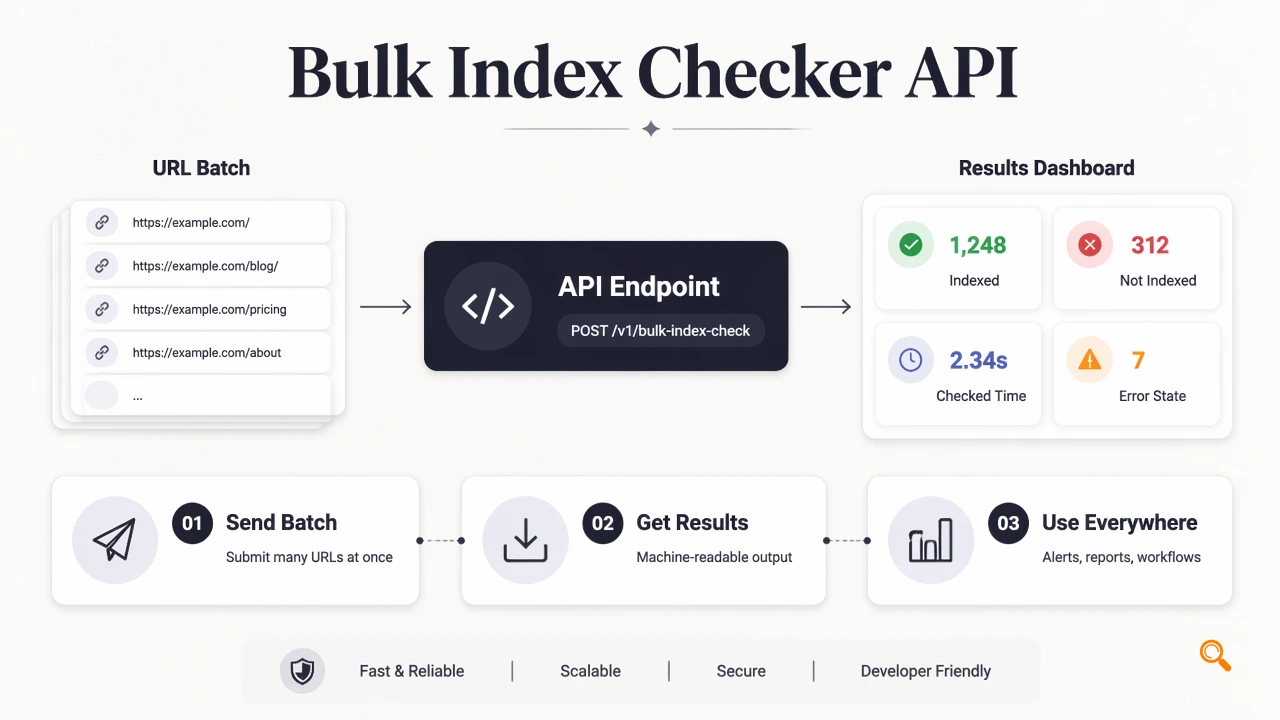
Bulk index checker API: an interface for submitting URL lists at scale and retrieving indexation results in formats that software, dashboards, and automation tools can process.
Key insight: the value is not only the index result; it is the ability to repeat the check reliably across changing URL inventories.
Core inputs and outputs to expect
| Element | Practical use |
|---|---|
| URL list | Product pages, blog posts, backlinks, or programmatic pages |
| Domain grouping | Separates properties, clients, or language versions |
| Schedule | Runs checks daily, weekly, or after publishing |
| Status field | Flags indexed, not indexed, unknown, or failed checks |
| Timestamp | Shows when the result was last verified |
Competitor pages in the research set focus heavily on free bulk checkers and one-off verification. Scaled SEO teams usually need more: stable inputs, consistent output schemas, and result history that can be joined with crawl, sitemap, and analytics data.
How should automated index checks run at scale?
Automated index checks should run as controlled batches with clear URL sources, rate-limit handling, retry rules, and schedule logic. This protects data quality and prevents noisy reporting when a temporary lookup failure gets mistaken for a real indexing issue.
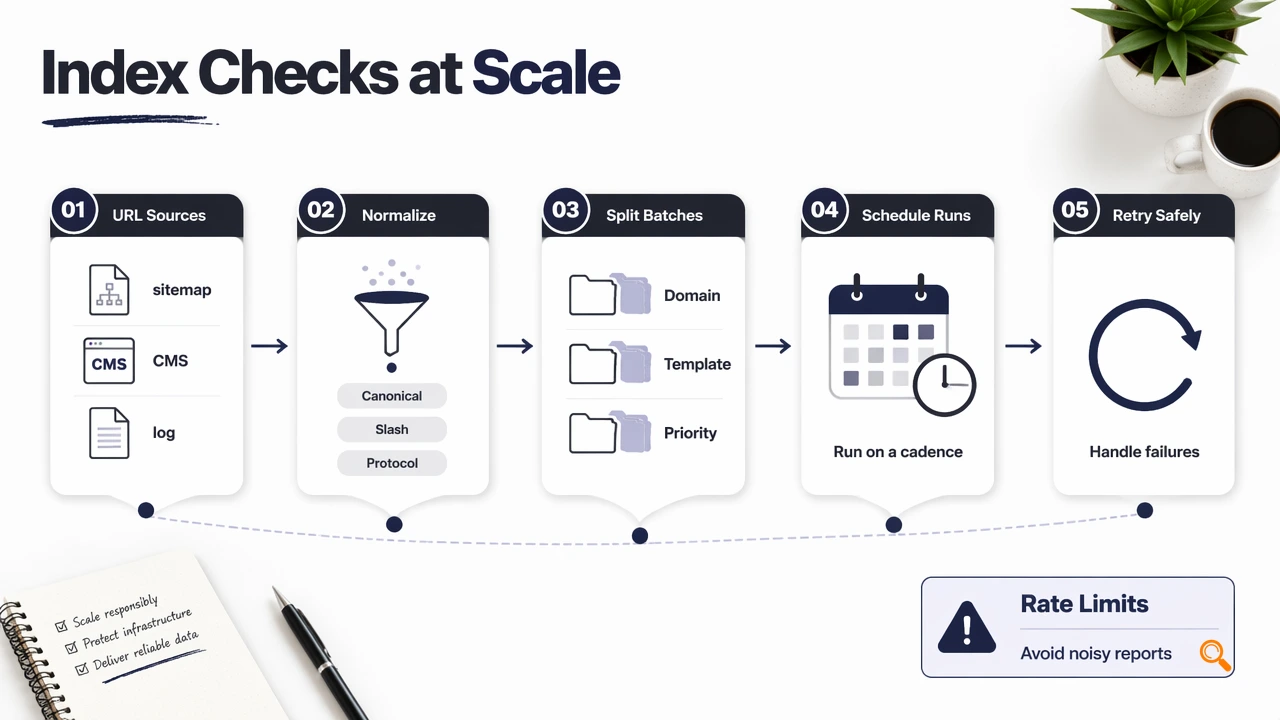
A practical workflow usually follows five steps:
- Pull URLs from XML sitemaps, CMS exports, logs, or backlink databases.
- Normalize canonicals, trailing slashes, protocol, and parameter rules.
- Split URLs by domain, template, priority, or publish date.
- Run scheduled checks with retry logic for failed or unknown responses.
- Export results into dashboards, tickets, or alerting systems.
The Indexerhub platform fits teams that need these checks to operate as part of a recurring SEO process, not as an occasional audit.
Scale controls that prevent bad decisions
| Control | Why it matters |
|---|---|
| Batch size | Keeps jobs predictable across large URL sets |
| Rate limits | Reduces failed checks and unstable response patterns |
| Retries | Separates temporary errors from real index gaps |
| Change history | Shows whether indexation improved or declined |
| Segmentation | Identifies weak templates, directories, or markets |
API reliability matters because indexing data often feeds automated decisions. Research by Bornholt, Joshi, and Astrauskas on validating an Amazon S3 key-value storage node shows why correctness checks in large software systems deserve formal attention, especially where stored results guide downstream processes (ACM, 2021).
How should index data feed SEO workflows in 2026?
Index data should feed prioritization, diagnostics, and publishing feedback loops rather than sit in a standalone report. In 2026, the strongest use case is connecting index status with page type, internal links, canonical tags, crawl depth, freshness, and revenue or traffic potential.
For content teams, missing indexation can signal weak internal linking, thin duplication, crawl waste, or sitemap drift. For agencies, the same data helps separate client-visible reporting from technical investigation. For SaaS and marketplace sites, template-level patterns matter more than single URL anecdotes.
Key insight: one URL not indexed is a symptom; one thousand similar URLs not indexed is a system signal.
Workflow mapping by SEO team type
| Team | Best workflow use |
|---|---|
| Enterprise SEO | Monitor templates, migrations, and priority page groups |
| Content operations | Confirm new and refreshed articles enter the index |
| Programmatic SEO | Detect directory-level indexation gaps early |
| Affiliate teams | Track money pages and important supporting assets |
| Agencies | Report index health across multiple client domains |
With Indexerhub, teams can connect recurring checks to a practical review cadence: investigate high-value missing URLs first, compare patterns by section, then escalate technical fixes only when the data shows repeatable failures. More product details are available at indexerhub.com.
Conclusion
A bulk index checker API is most useful when it becomes part of an operating system for SEO, with clean URL sources, scheduled checks, and action-ready outputs. The next step is to define priority URL groups, choose a checking cadence, and connect results to reporting or task workflows. For teams ready to reduce manual index audits, visit indexerhub.com and evaluate how automated monitoring fits the current publishing process.