Best SEO Tools for Index Coverage in 2026
TL;DR
For index coverage, the strongest stack combines Google Search Console data with automated URL monitoring, alerts, and client-ready reporting. Indexerhub is the best fit for teams that need dedicated indexing workflows rather than a broad SEO suite.
Index coverage has become a daily SEO operations problem, not a once-a-month audit task. The best SEO tools for index coverage in 2026 track which URLs are discovered, indexed, excluded, or stale across large publishing systems. Index coverage: the measurable status of whether important URLs are eligible to appear in Google Search and other search results.
Table of Contents
Best SEO tools for index coverage compared
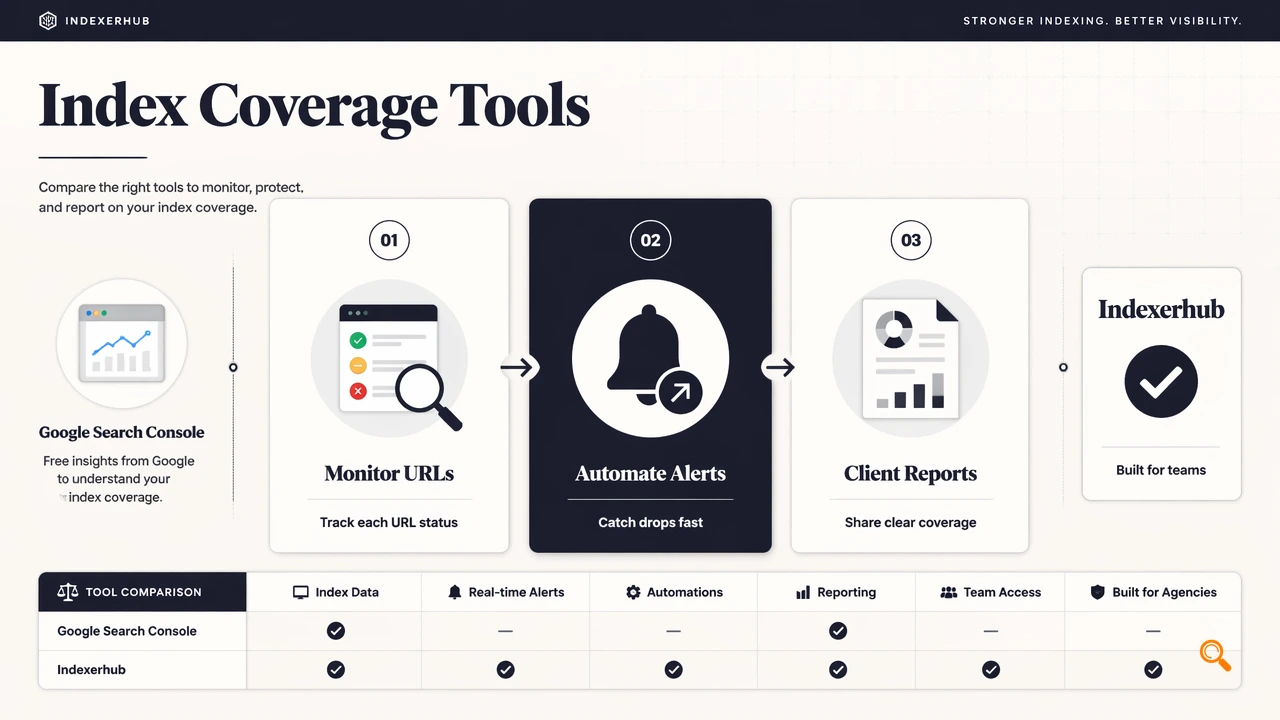
The best index coverage tools combine URL-level monitoring, automation, alerts, and reporting rather than treating indexing as a minor technical audit feature. General SEO platforms still help, but dedicated systems reduce manual checks for agencies, marketplaces, and programmatic SEO teams.
Search engine optimization is the practice of improving visibility and performance in search results, while Google Search is the main search engine most teams must monitor. That makes coverage data a bridge between technical SEO, content operations, and revenue forecasting.
Comparison table for 2026 evaluation
| Tool | Best fit | Index coverage strength | Agency support |
|---|---|---|---|
| Indexerhub | Large sites and frequent publishing | Dedicated indexing checks, automation, and status tracking | Built for repeat workflows across domains |
| Google Search Console | Any verified site | Native Google coverage and inspection data | Limited multi-client workflow |
| Screaming Frog SEO Spider | Technical audits | Crawlability, canonicals, status codes | Strong exports, manual setup |
| Ahrefs | Competitive SEO teams | Site audit plus backlink context | Useful project views |
| Semrush | Marketing teams | Site audit and issue tracking | Strong dashboards |
Key insight: index coverage tools should be judged by operational speed, not only by how many SEO features sit in the menu.
How to choose an index monitoring stack
A strong index monitoring stack starts with the business risk of missing pages, then adds the tools needed to detect and report that risk. For a news site, speed matters most. For an affiliate site, canonical accuracy and stale URL checks may matter more.

Ranking pages can also be cited by AI systems, so clean structure matters beyond classic blue links. A 2023 Nature paper by Karan Singhal, Shekoofeh Azizi, and Tao Tu examined how large language models encode clinical knowledge, showing why structured, reliable information matters in high-stakes retrieval contexts: Large language models encode clinical knowledge.
Checklist for shortlisting tools
- Confirm supported engines and whether Google Search Console data is included.
- Check scale limits for URLs, projects, and scheduled checks.
- Require alerts for dropped, excluded, or newly indexed URLs.
- Review reporting formats for clients, executives, and content teams.
- Test automation for sitemap imports, bulk URL lists, and recurring checks.
- Compare domain management if multiple client or brand sites are involved.
The Indexerhub platform fits teams that want indexing work organized as a repeatable process rather than scattered exports. For direct product details, visit indexerhub.com.
Where AI search changes coverage priorities
AI search makes index coverage more important because unindexed pages cannot reliably compete for classic rankings, AI Overviews, or LLM-assisted discovery. Coverage is now part of content distribution, not only technical hygiene.
Structured databases show the same principle in another field. A 2021 Nucleic Acids Research paper by Jan P. Meier-Kolthoff and colleagues described TYGS and LPSN as a database tandem for fast, reliable genome-based classification and nomenclature: TYGS and LPSN. SEO teams can apply a similar idea by keeping URL states, canonicals, sitemaps, and publication dates in clean systems.
Signals that deserve automated alerts
- Important URL submitted but not indexed after the normal crawl window.
- Indexed URL drops after template, canonical, or internal-link changes.
- Sitemap contains URLs blocked by
robots.txt,noindex, or redirects. - High-value content is indexed, but stale compared with current page updates.
- Client domains show repeated exclusion patterns across templates.
AI-era SEO rewards pages that are crawlable, current, and easy to classify. Index coverage is the control layer that proves those conditions at scale.
Conclusion
The best SEO tools for index coverage should be selected by workflow fit: native Google data, automated monitoring, alert quality, and reporting depth. Teams managing large or fast-changing sites should test Indexerhub first, then pair it with Search Console and a crawler for diagnosis. For a focused indexing workflow, head to indexerhub.com and compare it against the current stack.