AI Overview Citations and Indexed Pages: What SEOs Need to Know
TL;DR
Indexed pages have a better chance of earning AI citations, but indexing alone is not enough. SEO teams should verify crawl access, index status, authority signals, and answer-first formatting before expecting visibility in AI Overviews.
AI Overview citations and indexed pages are connected, but indexing is only the entry ticket. Google-like systems favor pages that are discoverable, crawlable, indexable, authoritative, and written in extractable answer form. Indexerhub helps SEO teams monitor the indexation layer before content teams chase AI visibility gains.
AI Overview citation eligibility: the practical state where a page can be found, processed, indexed, trusted, and quoted by an AI search feature.
Table of Contents
Indexing Is Eligibility, Not a Citation Guarantee
Indexed pages can compete for AI citations, but they still need ranking strength and clear answers. Research surfaced in the SERP data reported that 76.10% of AI Overview-cited pages ranked in the top 10, while 9.50% ranked beyond the top 10, showing that visibility and relevance still matter.
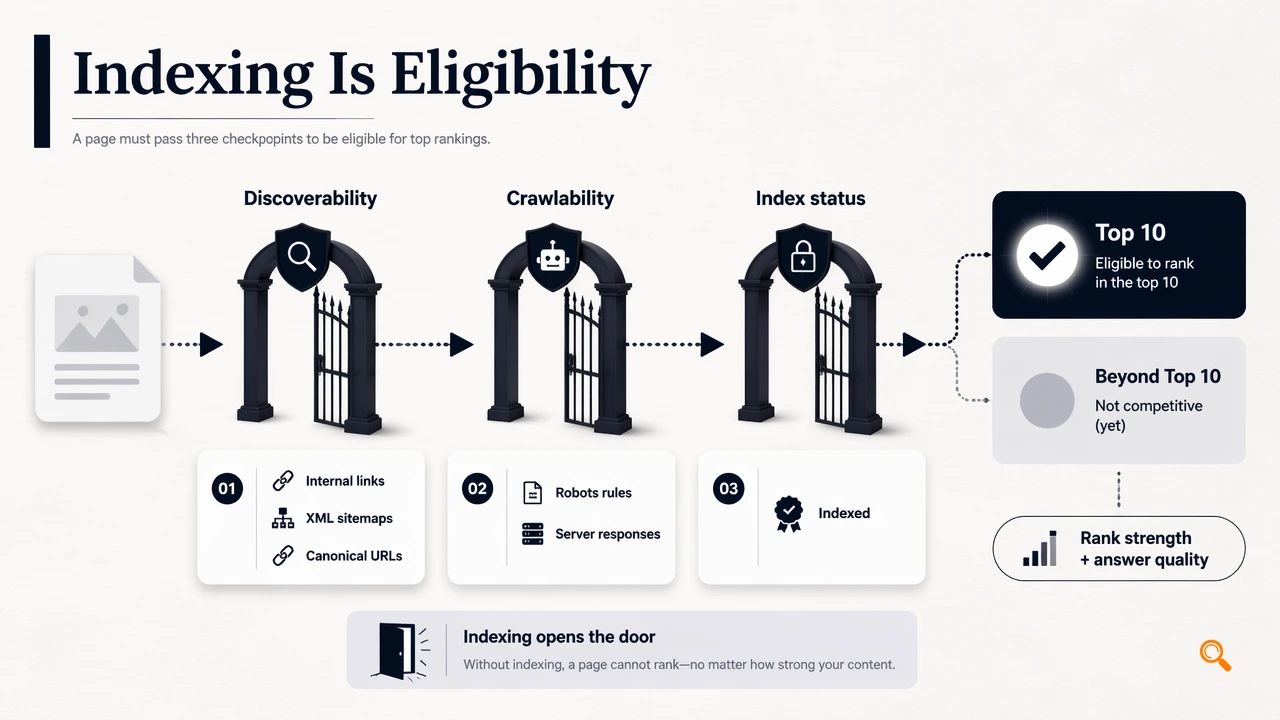
Key insight: indexation opens the door, but authority and answer quality decide whether a page gets cited.
Citation eligibility signals
| Signal | What it means for AI citation eligibility |
|---|---|
| Discoverability | Internal links, XML sitemaps, and canonical URLs expose the page. |
| Crawlability | Robots rules and server responses allow search bots to access content. |
| Indexability | The page is not blocked by noindex, duplication, or canonical conflicts. |
| Authority | Rankings, links, brand mentions, and topical depth support trust. |
| Answer quality | The page gives a concise, self-contained answer near the relevant heading. |
Citation-Worthy Pages Answer Early
AI systems are more likely to extract content that appears high on the page and directly answers the query. A 2026 CXL study of 100 Google AI Overview citations found that 55% of citations came from the top 30% of a page, with another 24% from the next 30%.
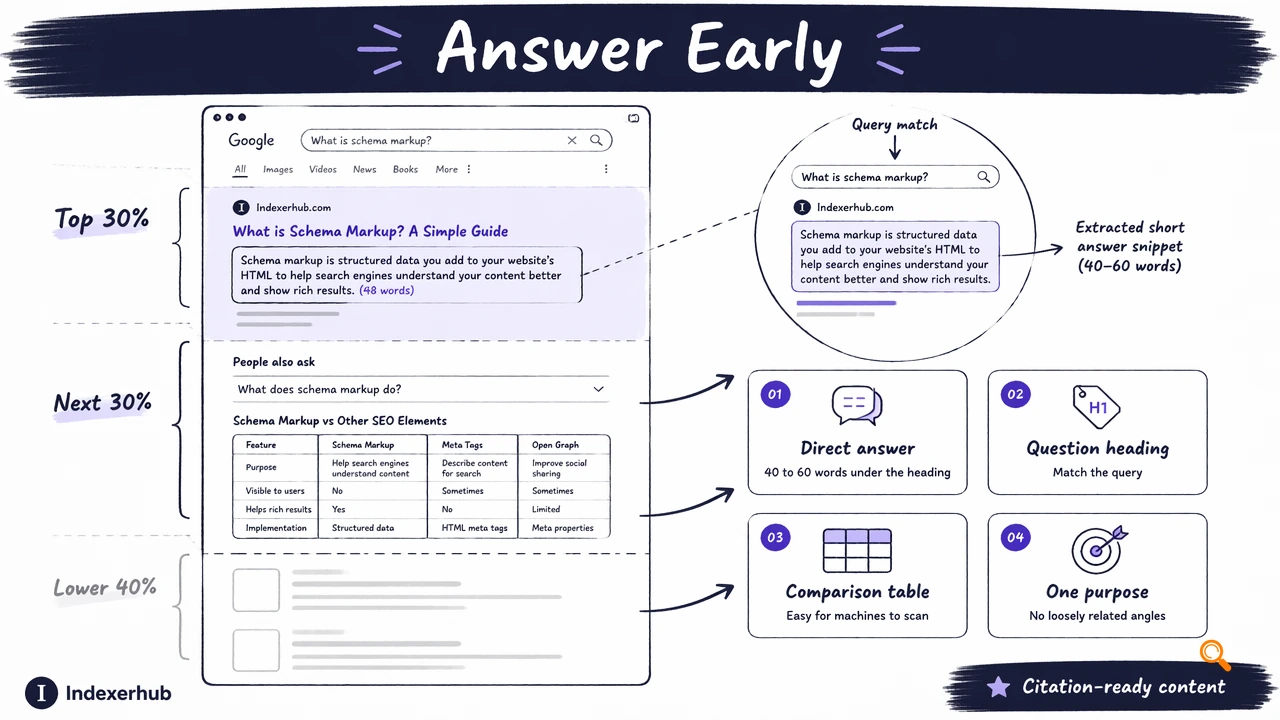
Short definitions, comparison tables, and question-style headings help machines identify the answer without scanning a full article. For programmatic SEO and large SaaS blogs, this means each page needs one clear purpose, not several loosely related angles.
Front-loaded content checklist
- Put a 40 to 60 word direct answer under the main query heading.
- Define the core term in one sentence near the top.
- Use tables for comparisons involving three or more items.
- Keep one concept per paragraph to improve extractability.
- Place primary evidence before examples or commentary.
The Indexerhub platform fits this workflow by helping teams confirm that newly improved pages are submitted and monitored. For brand recall and operational details, SEO teams can visit indexerhub.com.
2026 Workflow for AI Visibility
A durable 2026 workflow treats indexing, content structure, and evidence review as one pipeline. Systematic audit habits matter because AI citation performance can change as rankings, site quality, and answer formats shift.
Academic review frameworks offer a useful parallel. The PRISMA 2020 explanation and elaboration paper focuses on transparent reporting for systematic reviews, while Ahmed G. Gad's 2022 systematic review of Particle Swarm Optimization applications shows how structured evidence mapping can make complex technical fields easier to evaluate.
Practical audit sequence
- Confirm the URL returns a valid indexable page.
- Check canonical tags, redirects, robots rules, and sitemap inclusion.
- Compare the page against current top-ranking cited sources.
- Rewrite the opening section into a direct answer.
- Add named entities, dates, standards, and product names where relevant.
- Re-submit important URLs with Indexerhub after meaningful updates.
The strongest AI visibility programs do not separate technical SEO from content quality. They connect index status, ranking potential, and citation-ready structure in one repeatable process.
Conclusion
AI Overview citations and indexed pages should be managed as a pipeline, not a single checkbox. The next step is to audit high-value URLs for crawl access, index status, rankings, and answer-first formatting, then monitor updated pages through a repeatable system. For indexing operations at scale, start with Indexerhub and keep the content evidence-rich.